What’s the Buzz? Do Bees Prefer Caffeine to Sugar?
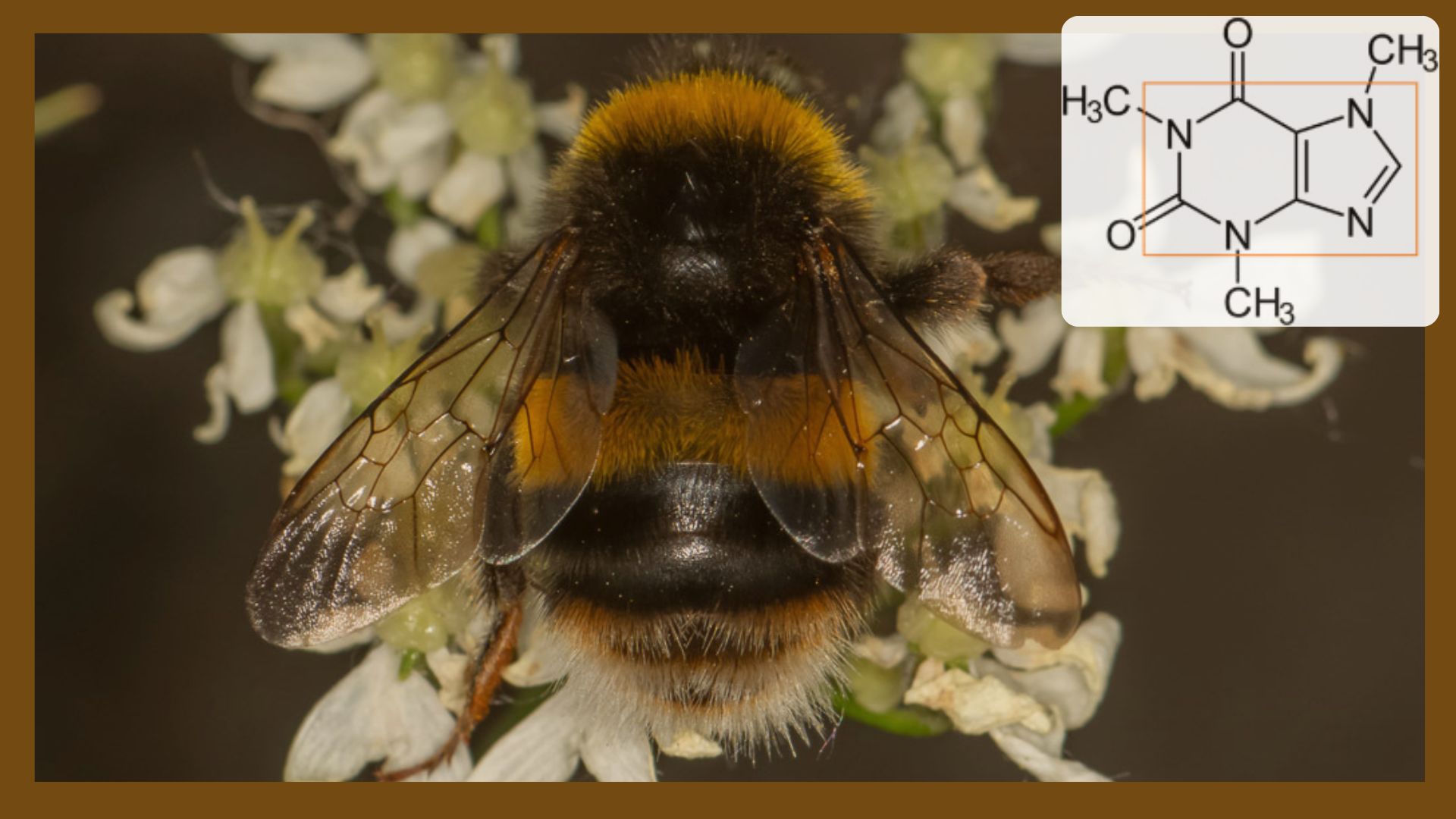
Image Source: Left Image British Buff Tailed Bumble Beeby neil 63530, CC BY-NC 4.0 via iNaturalist. Right Image Chemical structure of caffeine from Figure 1 of Reddy, et al. (2024)
Source Article: Ding, S., Ding, J., Jiang, H., Barron, A. B., Solvi, C., & Peng, F. (2026). Understanding the caffeine paradox: caffeinated nectar increases pollinators’ perceived value of flowers. Animal Behaviour, 231, Article 123417. https://doi.org/10.1016/j.anbehav.2025.123417
Secondary articles:
Hausler, C., Nawrot, M. P., & Schmuker, M. (2011). A spiking neuron classifier network with a deep architecture inspired by the olfactory system of the honeybee. 2011 5th International IEEE/EMBS Conference on Neural Engineering, 198–202. https://doi.org/10.1109/NER.2011.5910522
Motta, E. V. S., Arnott, R. L. W., & Moran, N. A. (2023). Caffeine Consumption Helps Honey Bees Fight a Bacterial Pathogen. Microbiology spectrum, 11(3), e0052023. https://doi.org/10.1128/spectrum.00520-23
Reddy, V. S., Shiva, S., Manikantan, S., & Ramakrishna, S. (2024). Pharmacology of caffeine and its effects on the human body. European Journal of Medicinal Chemistry Reports, 10, Article 100138. https://doi.org/10.1016/j.ejmcr.2024.100138
Ribi, W., Senden, T. J., Sakellariou, A., Limaye, A., & Zhang, S. (2008). Imaging honey bee brain anatomy with micro-X-ray-computed tomography. Journal of Neuroscience Methods, 171(1), 93–97. https://doi.org/10.1016/j.jneumeth.2008.02.010
Caffeine is the most popular stimulant and psychoactive substance in society. It can be found in cacao beans, tea leaves, guarana berries, and yerba mate plants, just to name a few sources. So, it is no wonder that caffeine is found in coffee, tea, chocolates, soft drinks, and medications. Modern day society is run by caffeine, but what about the bee world?
The following study examined whether bees preferred caffeinated flowers to plants with higher yields of sugar. After performing a series of tests, they found strong evidence that caffeine modifies bees’ perception of which flowers were more valuable. The effect was not immediate, but occurred when bees use long-term memory to remember caffeinated and noncaffeinated flowers. Although the caffeine preference may be a no-brainer, the study offers insights to plant competition strategies, and pollinator behavior.
The Caffeine Paradox: Simultaneously Sick, Healed, Hooked, and Productive
In the plant world, certain compounds such as caffeine, nicotine, and cocaine are used to keep animals away. Typically, they are bitter, toxic, and deter animals from ingesting it. On the other hand, they can be addictive and encourage an animal to associate with the plant and can even be beneficial. According to the researchers in this study, these rewarding and reinforcing effects have been traditionally considered a side effect or evolutionary byproduct.
At high doses, caffeine can be toxic and can make you vomit. Where is the reward with these consequences? As any experienced coffee drinker would explain, you have to get the dose just right. Caffeine is naturally present in citrus nectars at a dose below the taste threshold for bumble bees, but is still psychoactive for pollinators and can improve remembering which flowers are caffeinated. Different studies have found that at low levels, caffeine can enhance bees’ foraging activities, enhance pollen collection, and reduce flower handling times.
Additionally, caffeine can have medicinal benefits as well. In one study, microbiota-colonized bees exposed to caffeine were more resistant to the bacterial pathogen Serratia marcescens. Caffeine can also reduce spore density of the fungal disease Vairimorpha spp., and reduce virus infections by increasing immunity in bees.
Are the Neural Mechanisms Affected by Caffeine Different Between Humans and Bees?
 |  |
In humans, caffeine can bind to adenosine receptors and inhibit them. Adenosine receptors are responsible for the regulation of alertness, memory, learning, and emotional responses. When caffeine blocks these receptors, it blocks the brain from sending fatigue sensations. This is why the body feels alert and awake after the consumption of caffeine.
In addition, caffeine influences the brain reward system. Although it is not considered a typical drug like cocaine and amphetamine, it is still believed to raise the concentration of dopamine in the nucleus accumbens (NAc), the main pathway to reward association in drug addiction. Dopamine is the dominant reward learning and reinforcing chemical of rewards conserved across vastly different species.
In the case of bees, these insects have a similar system to humans. Biogenic amines, such as dopamine and octopamine, play an important role in associative learning and reward. Olfactory information, such as the presence of caffeine, is first processed in the antennae lobe. This information is then sent to the mushroom body, which is the main area for sensory processing, reward, and behavior responses.
Experimental Set Up: Get These Bees Some Sugar, Water, and Caffeine

Does caffeine change pollinators’ valuation of flowers? How do you test such a question? Forager bees (Bombus terrestris audax) from 9 colonies were pretrained and trained to collect sugar water from eight colored artificial flowers in a small arena. First, they were allowed to roam freely in the set up arena. Whichever bees entered the arena of their own will and landed on a flower were given a number tag to its thorax for identification. How? With the tip of a toothpick and a small amount of superglue!
Tagged Bombus terrestris audax forager bees were then trained individually on eight flowers of one color on one day and an alternate color the next day. Cyan flowers were uncaffeinated while orange flowers contained caffeine. On the third day, they were allowed to visit both flower types. Bees initially showed no preference. In subsequent experiments, researchers then performed a differential training experiment, meaning bees were given different flower options simultaneously rather than in separate areas. Again, Bombus terrestris audax had the choice of two flower types: one caffeinated and the other noncaffeinated. The experiments carried out varied the sugar concentrations of both flowers to determine which flower the bee would prefer. Flower colors were counterbalanced, either orange or cyan could be caffeinated, depending on the experimental group. This prevented any color caffeine correlations. After 24 hours, bees preferred caffeinated flowers.
What is the Value in Caffeinating Bees? Applications and Interesting Unknowns
Preferring caffeine feels like a no-brainer in this study, so what value did this study serve? Although the results were intuitive, this study touched on several fields for consideration. From an ecological perspective, this study highlighted how plants can be competitive by modifying pollinator behavior through the use of stimulants. Chemicals that are traditionally seen as defense mechanisms can also be an attractant at the right concentrations. Understanding pollinator behavior and plant strategies inform researchers and policy makers on how to create a sustainable habitat that supports pollinators.
Like other species, bees are affected by reward systems. They can become dependent on alcohol, display potential addiction-like changes with cocaine withdrawal, and can be influenced by opioids in spite of lacking an endogenous opioid system.Bees are a useful model in addiction behavior studies and can compete with the traditional fly model. It has the best of both worlds: a moderately complex neurological system that is easier to study.
The bee raises interesting questions about how learning is affected by addiction in a social environment. Decisions aren’t just made by the individual bee, they are also regulated by the queen who sends out pheromones. Dopamine appears to regulate associative learning, reward, and social roles in the colony, but it is not completely understood.
If the conclusion of this study summary seems too bee-zy (pun intended), just take a coffee break and remember, bees prefer their drinks to be very sweet, but low in caffeine.
Reviewed by: