
Coral: The Landlords of the Sea
Featured Image Caption:
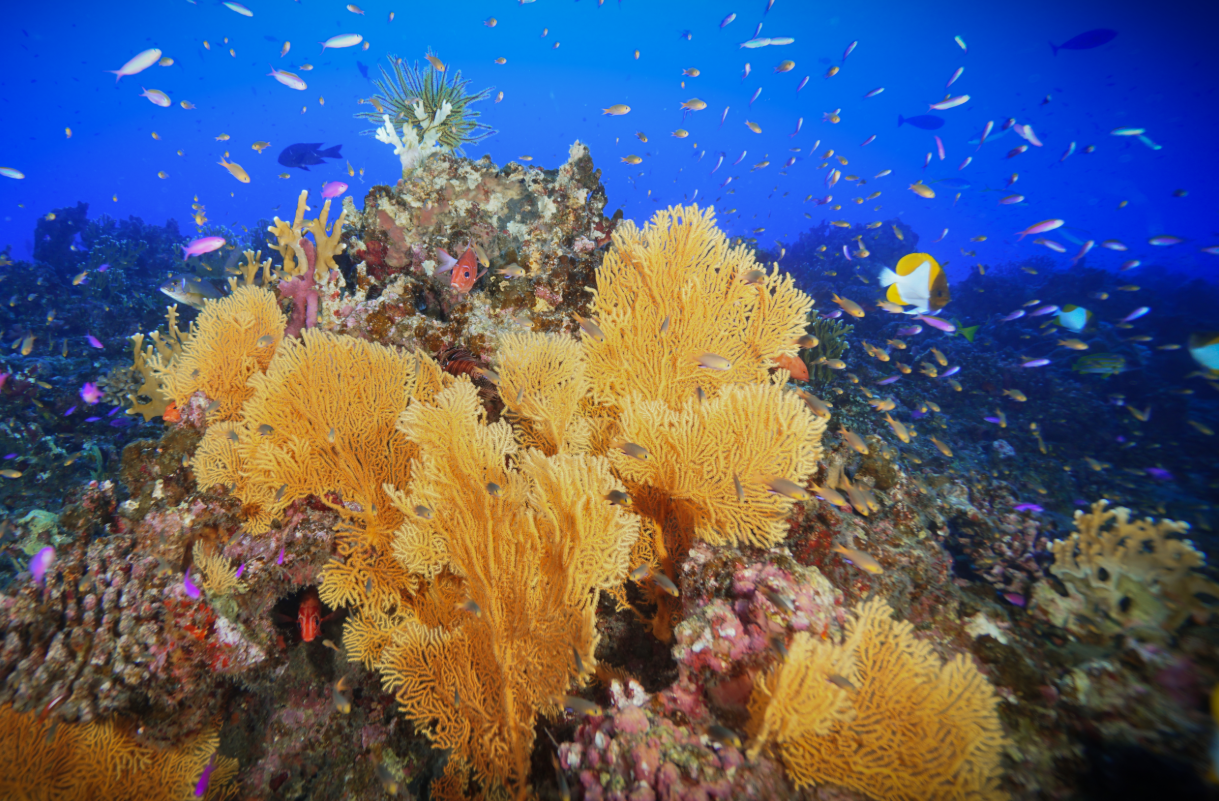
Sea fans on a robust Coral reef off the coast of Pagan Image Source: Reef assessment and habitat mapping in the Marianas by NOAA Fisheries/Andrew Gray, Public domain, via Wikimedia Commons Retrieved June 9, 2026
Source Article:
E. P. Santoro, R. M. Borges, J. L. Espinoza, M. Freire, C. S. M. A. Messias, H. D. M. Villela, L. M. Pereira, C. L. S. Vilela, J. G. Rosado, P. M. Cardoso, P. M. Rosado, J. M. Assis, G. A. S. Duarte, G. Perna, A. S. Rosado, A. Macrae, C. L. Dupont, K. E. Nelson, M.J. Sweet, C. R. Voolstra, R. S. Peixoto, Coral microbiome manipulation elicits metabolic and genetic restructuring to mitigate heat stress and evade mortality. Sci. Adv. 7, eabg3088 (2021).
Secondary Articles:
Corals of the World. (n.d.). Corals of the World. Retrieved May 19, 2026, from https://www.coralsoftheworld.org/species_factsheets/species_factsheet_summary/mussismilia-hi spida/
Corals Tutorial: What are corals? (n.d.). NOAA’s National Ocean Service. Retrieved May 19, 2026, from https://oceanservice.noaa.gov/education/tutorial_corals/coral01_intro.html NOAA Coral Reef Watch Current Global Bleaching: Status Update & Data Submission. (n.d.). NOAA Coral Reef Watch Homepage and Near Real-Time Products Portal. Retrieved May 19, 2026, from https://coralreefwatch.noaa.gov/satellite/research/coral_bleaching_report.php NOAA Coral Reef Watch Tutorial. (n.d.). NOAA Coral Reef Watch Homepage and Near Real-Time Products Portal. Retrieved May 19, 2026, from
https://coralreefwatch.noaa.gov/product/5km/tutorial/crw02b_more_bleaching.php Rosado, P. M., Leite, D. C. A., Duarte, G. A. S., Chaloub, R. M., Jospin, G., Nunes da Rocha, U., Saraiva, J. P., Dini-Andreote, F., Eisen, J. A., Bourne, D. G., & Peixoto, R. S. (2018). Marine probiotics: increasing coral resistance to bleaching through microbiome manipulation. The ISME Journal, 4, 921–936. https://doi.org/10.1038/s41396-018-0323-6
When corals met algae: Symbiotic relationship crucial to reef survival dates to the Triassic. (n.d.). Princeton University. Retrieved May 19, 2026, from
https://www.princeton.edu/news/2016/11/02/when-corals-met-algae-symbiotic-relationship-cru cial-reef-survival-dates-triassic
Off the coast of Brazil, under deep cobalt waves, lies a hidden world of underwater wonders. Beneath the ocean’s surface, the waters are home to a continually growing number of fascinating species.
However, as climate change steadily increases sea temperatures, some species are seemingly facing the climate chopping block. Corals are colonial organisms, multiple tiny creatures that come together to create one of the most magnificent ecosystems on earth: the coral reefs. Corals are home to thousands of sea creatures, including ones that can only be seen under a microscope.
Climate Change Has Done It Again!
When coral is exposed to high temperatures, they shed the Zooxanthellae that provide most of the coral’s energy. Take, for example, the algae of the family Symbiodiniaceae. Symbiodiniaceae, also called “Zooxanthella,” are the primary organisms responsible for the color of the coral. The Zooxanthellae go from energy factories to toxin-producing waste plants, spewing out reactive oxygen species that damage the coral. It is this ejection of the microscopic algae that leads to the devastating white color of “bleached” coral.
Without the algae, the corals slowly starve and eventually perish, leaving a landscape of ghostly polyp shells and a devastated ecosystem. But not all hope is lost as a group of scientists in Rio de Janeiro have been looking at how administering helpful bacteria inside the coral species M. hispida can help protect it from bleaching.

The Nitty Gritty and Bacterial Buddies
These symbiotic algae work to provide the coral with energy, up to 90% of it in fact, via photosynthesis in exchange for a cozy place to call home. Zooxanthellae aren’t the only ones living in the coral though. A myriad of bacteria, viruses, fungi, and other protists dwell within the coral, establishing what is known as a “holobiont”.
Holobionts are characterized as an organism and all the microorganisms it contains. Like humans, coral have a diverse microbiome that may be crucial to their survival.
The group of scientists retrieved coral off the coast of Brazil in the Coroa Vermelha reefs. Coral samples were then brought into the lab and exposed to bleaching conditions, with a control temperature of 27℃ and an experimental temperature of 30℃. The two separate groups were then tested: a control group given a saline solution placebo and an experimental group given a cocktail of beneficial bacteria. The bacteria selected were chosen from existing thermo-tolerant coral microbes and isolated for their unique nitrogen fixing, sulfur cycling, reactive oxygen dismantling, and antibiotic properties.
Together, the beneficial bacteria B. lehensis, B. oshimensis, M3 B. lehensis, B. conglomeratum, P. rifietoensis, and Salinivibrio sp. were dubbed the Beneficial Microorganisms for Corals (BMC) consortium and served as a coral probiotic. Within an artificial sea environment pool called the mesocosm, the effects of thermal bleaching were observed in both the probiotic and placebo groups and compared to the 27℃ baseline.
The scientists found that not only had the coral exposed to the BMC probiotic fared better under thermal bleaching conditions, but had actually demonstrated a 100% survival rate (50% lightened, 50% bleached) when compared to the 100% bone white bleached (50%) and dead (50%) coral seen in the placebo.
The bacteria seemingly act as caretakers for the corals while they are undergoing thermal stress and even help mitigate after effects. In a condition known as “Post Heat Stress Disorder” also referred to as PHSD, corals continue to suffer damaging effects even after the heat has gone away. The bacterial cocktail managed to prevent PHSD by providing the coral with a variety of mechanisms that help decrease unwanted inflammation and damage in the coral on both an organismal and cellular level.
Examples of this include outcompeting disease-causing Vibrio sp. for space in the holobiont, as well as helping initiate transcription factors that turn on restructuring and repair genes within the coral, decreasing apoptosis, and even recruiting other helpful bacteria within the coral to join in on the healing process.
Unfortunately, the BMC probiotic bacteria do eventually dissipate, leaving behind a coral that may potentially be in distress. However, scientists think that by providing multiple rounds of bacterial administration, the healing effect can be prolonged. There is also talk of using the probiotic as a prophylactic of sorts, administering it before a heat shock event to create a microbial shield against the damaging effects of thermal bleaching.

Not All Hope Is Lost
Climate crisis-related bleaching has already affected 84% of the world’s coral reefs. And while reconstruction efforts continue to be put into effect, climate change continues to cause mass bleaching in coral species. With the use of BMC probiotics in corals, we can one day hope to shield the growing corals enough to nurture and usher them into beautiful reefs, resurrecting the once thriving ecosystems and creating new hope for thousands of sea species. So the next time you hit the beach for a swim, take a second to appreciate the corals and all the creatures that call them home sweet home.
Reviewed by:


