
Bat-tle for the ages: A Potential Treatment for White-Nose Syndrome in Bats
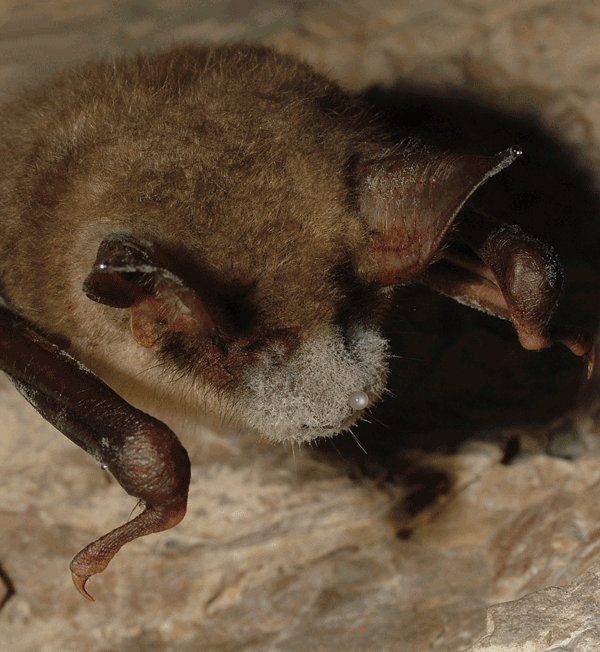
Featured Image Caption: Myotis Mytis with White-Nose Syndrome : 10-0002-F1.gif: Gudrun Wibbelt, Andreas Kurth, David Hellmann, Manfred Weishaar, Alex Barlow, Michael Veith, Julia Prüger, Tamás Görföl, Lena Grosche, Fabio Bontadina, Ulrich Zöphel, Hans-Peter Seidl, Paul M. Cryan, and David S. Blehert derivative work: Achim Raschka (talk) 23:52, 19 January 2012 (UTC), Public domain, via Wikimedia Commons
Source Article:
Gabriel, K. T., McDonald, A. G., Lutsch, K. E., Pattavina, P. E., Morris, K. M., Ferrall, E. A., Crow, S. A., & Cornelison, C. T. (2022). Development of a multi-year white-nose syndrome mitigation strategy using antifungal volatile organic compounds. PLOS ONE, 12, e0278603. https://doi.org/10.1371/journal.pone.0278603
Secondary Articles and Sources:
Tricolored Bat (Perimyotis subflavus) | U.S. Fish & Wildlife Service. (n.d.). FWS.Gov. Retrieved July 6, 2026, from https://www.fws.gov/species/tricolored-bat-perimyotis-subflavus
What Is White-nose Syndrome? (U.S. National Park Service). (n.d.). NPS.Gov Homepage (U.S. National Park Service). Retrieved July 6, 2026, from https://www.nps.gov/articles/what-is-white-nose-syndrome.htm
White-nose Syndrome FAQs (U.S. National Park Service). (n.d.). NPS.Gov Homepage (U.S. National Park Service). Retrieved July 6, 2026, from https://www.nps.gov/articles/white-nose-syndrome-faqs.htm
Perimyotis subflavus – Bat Conservation International. (n.d.). Bat Conservation International; https://www.facebook.com/BatCon. Retrieved July 6, 2026, from https://www.batcon.org/bat/perimyotis-subflavus-2/
Poor Cuties With the White Noses
Bats. Bats. I’m going to say it one more time for dramatic effect and also because it’s fun: bats. Bats are some of nature’s most impressive creatures. They are the only mammals capable of TRUE flight (I’m looking at you sugar-gliders, you shifty charlatans). They are an integral part to many ecosystems serving as pollinators, pest control, and seed sowers. North America in itself is home to over 50+ species of bats, with the tricolored bat (Perimyotis subflavus) being one, to note, in particular. It is one of the smallest bats in North America and can be found in the central and eastern parts of the United States as well as southern parts of Canada. They are primarily a solitary species that can sometimes form small colonies.
However what they have become known for is their susceptibility to a fungal disease known as white-nose syndrome (Pseudogymnoascus destructans, Pd). White-nose syndrome has wiped out nearly 90-100% of all tricolored bats in the locations where it has been isolated. The infection usually catches them while they are hibernating, when their body temperatures are cooler, and makes it more difficult for them to preserve their fat stores that they require for energy.
Over time the fungus takes over their muzzles (hence the name white-nose syndrome) and wings, gradually causing the bats to waste away. White-nose doesn’t just affect the tricolored bat either; since the disease affects hibernating bat species, nearly 50% of all bat populations have been decimated with millions of bat deaths reported across North America.

Looking away from the skies, it turns out the solution may be underground. Certain bacterial species such as Rhodococcus Rhodochrous (what’s a seals favorite bacteria? Rr! Sorry.) have been shown to produce compounds that halt fungal growth (fungistatic compounds). When a compound is very quick to evaporate at room temperature these compounds are called “volatile”. A lot of these fungistatic compounds can be made into volatile compounds dubbed volatile organic compounds, also known as VOC (I know I’ve said compounds a lot, just bear with me). When put into a closed container with the P. destructans fungus, these VOCs are able to inhibit the growth of the fungus.
The World’s Most Scientific Humidifier
A group of researchers in Georgia have set out to examine a long term treatment for white-nose syndrome in tricolor bats using VOCs. By creating a misting system of sorts, the researchers were able to take a working concentration of a VOC mixture, a VOCtail if you will, of B-23 or B-23 + decanal respectively (both of which or antifungal properties). The great thing about these mixtures is that they can be easily applied via aerosolization and do not pose a detrimental effect to the environment nor the bats. Fun fact B23 is an isolate that came from a wild pineapple, how cool is that?
The Black Diamond Tunnel is a location that hosts a substantial amount of tricolored bats. It is an unfinished railway tunnel that was left abandoned after the civil war. It was never complete and over time it collected water due to its slope, creating a subterranean lake. This subterranean lake became very important to the researchers and they used a buoy to anchor one side of a pulley. The other pulley, with a winch ( a winding mechanism used for pulling heavy objects), was set up near the entrance of the cave. It is on this manufactured track that a flat-bottomed boat and the aerosolizing device were set up. The idea was that the device would travel on the boat being pulled by the pulley track, spraying out a roughly calculated dose of VOC antifungals. Surveys were made 3 times a year: once in the fall before treatment, a second in mid winter for treatment, and in the early spring post treatment.

But Does It Work?

The bat population in the tunnel used to be more than 5,000 bats, but after the arrival of Pd that number dropped to barely a little more than 200. Over the course of 6 years the treatment was administered. The bat population rested stably within the 170-270 range for the first 4 years. However, the numbers did not decrease drastically as they had before. On top of that, in the last 2 years the treatment demonstrated an effective population growth spurt into the mid 300s. This treatment, while preliminary, did in fact create a positive change in the bat population within the Black Diamond Tunnel System. The data may not be staggering, but it is a very promising start to what very well may be a working solution to the white-nose syndrome crisis. On a smaller scale this data is good news and one day it may be the source of much greater news if and when it ever gets implemented on a larger scale.
I Love Bats So Much: A Conclusion Filled With Love
Species loss is never a good thing (except in the case of mosquitos, I will die on that hill). To see such a robust population of very beautiful creatures drop so quickly is truly devastating. White-nose syndrome has, and will continue, to ravage hibernating bat populations until proper medical remediation is set into place. With the work of fantastic scientists like the ones discussed above, we can all maybe look forward to the day when the bats population flies back around. Until then, remember not to enter caves you’re not supposed to, keep cave areas clean, do not directly interact with bats, and report any strange bat activity to local wildlife authorities, and of course: just look at those cuties fly!

Reviewed by:


