
Human Activity is Rewiring Earth’s Climate Connections
Source Article: Vos, E., Huybers, P., & Tziperman, E. (2026). Climate change alters teleconnections. Geophysical Research Letters, 53(2). https://doi.org/10.1029/2025gl119307
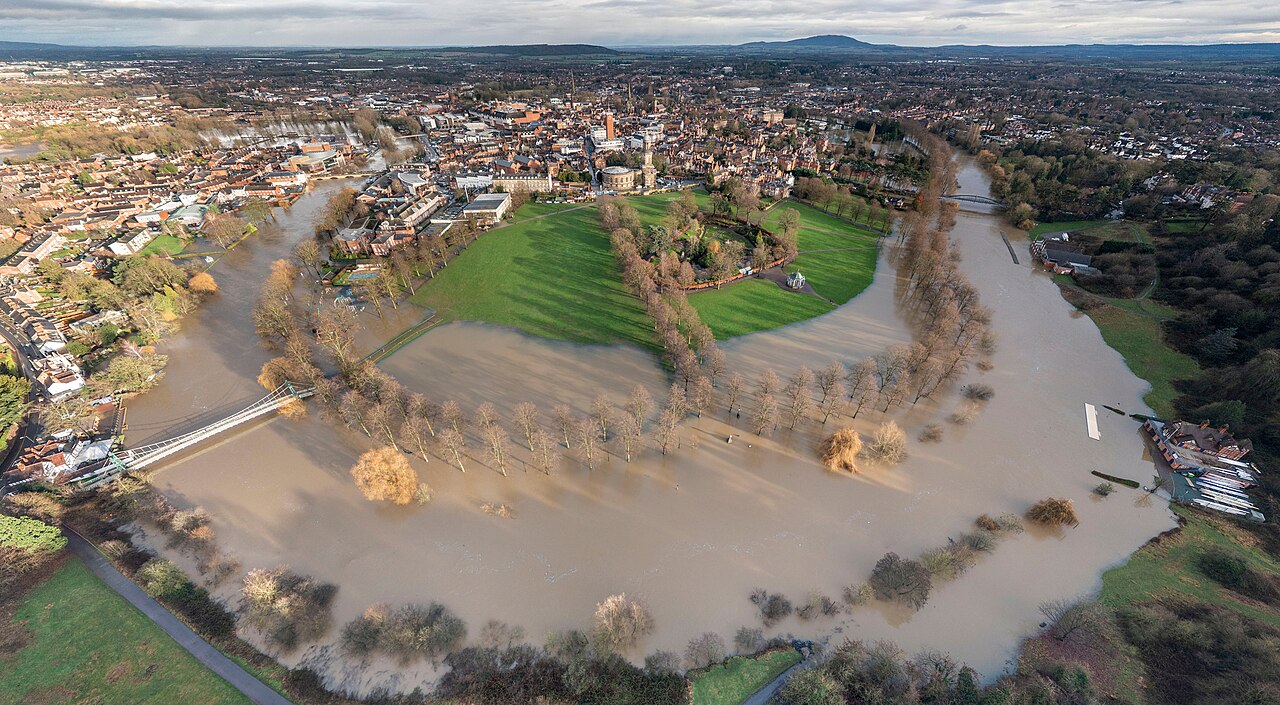
Featured Image Caption: climate change is altering the way connections between remote areas in the world behave, more often than not leading to disastrous consequences. (River Severn in flood in Shrewsbury by TCExplorer is licensed under CC BY-SA 2.0, via Wikimedia Commons)
I don’t know about you, but sometimes the urge to check on weather bulletins for the summer is irresistible. And every year, the same verdict: yes, this one will be the hottest year on record. After that, some familiar “El Niño/La Niña” references come and buzz around me, while I disconsolately stare at the fan trying to convince a lazy breeze to blow.
Of all that we hear though, it’s never really clear how scientists get to these claims and why should localized events (take El Niño/La Niña, for instance) have such an extensive impact worldwide. We are mostly told they do, and that anthropogenic influence is negatively affecting their behavior. So I thought, for the curious Envirobites bunch, that delving a little deeper into these topics would help in making some sense of the insufferable heat.
And the perfect opportunity came when I stumbled on a recent paper published in Geophysical Research Letters. The article analyzes the relationship between the climate phenomena we use for seasonal forecasts and regional weather systems all over the world, specifically focusing on how these connections changed and might change in the future in response to human activity. Exactly what we were looking for.
A Fragile Web
El Niño/La Niña is not the only event whose effects manifest in geographically distant areas on Earth. Several exist in fact, and scientists call them climate modes – periodic patterns of variation, regarding sea-surface temperature, pressure or other such quantities, occurring over specific regions in the world. To monitor the state of a climate mode, researchers collect measurements of these quantities and then condense all info into a single number – the climate index – updated over time to track the pattern’s cycle. But that’s only half of the story.
The other core aspect concerns how climate modes exert their influence worldwide through a network of teleconnections, literally connections at a distance. These represent links to far away regions on Earth that are not attributable to mere chance, but rather backed by physical pathways transporting energy via atmospheric and oceanic circulation (you may have heard of Rossby waves or the global ocean conveyor belt).
And what does this energy do once at its destination? Well, it affects the balance of local weather systems inducing precipitation, for example, or none at all. It can also modulate the intensity and frequency of extreme phenomena that occur in a region. Maybe even increase the likelihood of such phenomena developing in previously unaffected areas. Along with a whole, long list of other consequences.
So, it’s safe to assume that climate modes and their teleconnections govern critical and very delicate processes which are best not to interfere with. Unfortunately though, optimistic environmental protection policies and their sluggish (when not negligent) application, have led to significant alterations to these mechanisms. And not for the better.
This is an Emergency Broadcast
To get a hold of these changes, three scientists from the Ecole Polytechnique and Harvard, focused on comparing teleconnection behaviors registered in a pair of consecutive 30-year periods (1960-1990 and 1990-2020) using two complementary approaches.
The first one relied on analyzing how much sea-surface temperatures around the world would rise or fall together and then compiling color-coded maps to show the strength of these relationships. After that, researchers took the difference between results from the two periods and immediately noticed shifts in teleconnection patterns.

To establish whether such changes could be linked to human activity, the team initially produced a score meant to test outcome similarity between observations and climate models. Then, to have a solid reference to compare to, the same process was repeated for a thousand random pairs of consecutive 30-year periods run in simulations with no anthropogenic influence.
Perhaps unsurprisingly so, none of these latter scores matched or even came close to the initial one, indicating that no natural variability could cause the observed shifts.
The second method aimed at characterizing, for each point on the globe, how sensitive sea-surface temperature and pressure would be to several climate modes. Beyond generally confirming results from previous analyses, the comparison between sensitivities from the two periods revealed that changes mostly affected the medium through which teleconnections operate, altering the way regions locally respond rather than how the modes themselves act.
At the very end of the paper, scientists also shared climate projections for both approaches up to 2070-2100, attesting to the presence, under the worst-case emission scenario, of the same trends identified throughout the whole study (still cautioning future research to possibly confirm these results in less extreme conditions too).
But What’s All of This Telling Us?
It’s become undeniable that the climate situation is changing and has already changed at a faster rate than we anticipated. While many shifts may be immediately perceivable (sea-ice melting, water levels rising, a hotter planet and so on) others, such as the ones discussed in this paper, have proven to be more subtle and covert. All share one common feature though: none can be reasonably attributed to spontaneous processes any longer.
The upcoming challenges associated with these latter changes in particular, are quickly growing past universally valid strategies and are increasing in complexity. There is a clear urgency to tackle region-specific issues which have begun developing just now or that have recently escalated in intensity, leading to severe issues impacting people across the world.
Think of droughts and hail ruining crops. Cyclones and floods destroying houses. Or wildfires burning through forests and cities alike. And while all of this happens, humanity keeps on pushing for division at a most critical moment, seemingly oblivious to the fact that we either all make it out of the current climate emergency or no one will.
Reviewed by:


.jpg)