Walking on Egg Shells: Understanding how Life History Contributes to Successful Egg Hatching in Birds.
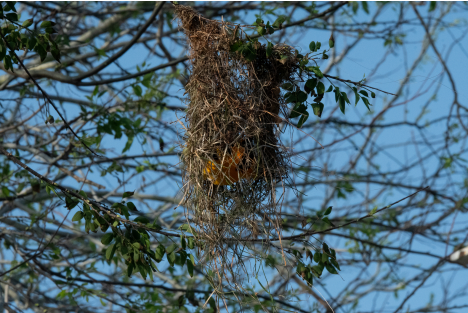
Featured Image Caption: Altamira Oriole (Icterus gularis) constructs a nest in preparation for laying eggs. Photo by Ian Becker (author)
Primary Source Article: Heggøy, O., Gohli, J., Johnsen, H. D., & Lislevand, T. (2026). Life history and ecology shape global patterns in avian hatching failure rates. BMC Ecology and Evolution, 26(1), 35.
Secondary Source Articles:
Koenig, W. D. (1982). Ecological and social factors affecting hatchability of eggs. The Auk, 99(3), 526-536.
Stoleson, S. H., & Beissinger, S. R. (1999). Egg viability as a constraint on hatching synchrony at high ambient temperatures. Journal of Animal Ecology, 68(5), 951-962.
Too Cold, too Hot, and Hopefully Just Right
When I was in elementary school, every year a pair of American Robins (Turdus migratorius) would return to the balcony outside my parent’s bedroom to nest. Every year a clutch of perfectly light blue eggs would appear atop the nest, but never did all of these hatch.
Despite our best efforts, one cannot simply will an egg to hatch. In fact, around 10-15% of eggs in a given clutch will remain after a nesting period, failing to hatch. Failure to hatch may not be solely a result of unfertilized eggs, but rather may be a function of factors impacting the development of a present embryo.
Avian embryos require an optimal temperature range or “goldilocks zone” to fully develop into fledglings. Eggs that get too cold or too hot may be prone to inhibited development effectively resulting in a hatching failure. But of course, the life histories of certain species of birds have accounted for this. The conditions an egg experiences are modulated by how a parent incubates the egg, how the nest is built, the physical dimensions of that egg.
Birds have some incredibly clever ways to deal with the effects of temperature on their offspring. However, natural forces are still at play. Curiously, hatching failure rate is actually negatively correlated with latitude, meaning that overall an egg is more likely to hatch the farther it is from the equator (Koenig 1982).
A recent study published in BMC Ecology and Evolution sought to understand why exactly this is the case. Perhaps larger clutch sizes means more eggs are exposed to harsher conditions for more time. Perhaps the life history of an individual species means it may be more beneficial to be selfish and focus on themself instead of propagating offspring. In either case, this latitudinal hatching success pattern may boil down to these interspecific (between different species) differences.
Understanding a Global Carton of Data
The authors, hailing from Norway, constructed a global dataset of hatching failure rate from previously published studies spanning 521 species and 26 phylogenetic orders. In order to isolate natural causes of hatching failure rate, they excluded studies with any artificial manipulation of the incubation process as well as known inbred populations.
They gathered life history trait data for each species (nest type, nest site, incubation period, clutch size, egg size) using available literature and collected latitude/altitude data from each respective study.
In order to explore how hatching failure rate was related to all of these traits, the authors built multivariate beta regressions. In less jargony terms, this is a type of model that is able to properly deal with “skewed” data such as hatching failure rate of which many studies reported values close to 0.
Hatching failure overall was highest at lower latitudes and declined at higher latitudes, similar to previous findings (Koenig 1982, Stoleson and Beissinger 1999). However, this effect was dependent on clutch size and species with larger clutches at low latitudes actually experienced higher failure rates relative to other species. Life history also played a leading role. Generation length, or rather the average life span of a species was positively correlated with hatching failure rate meaning that longer lived species had higher instances of eggs failing to hatch. Furthermore, species that placed nests above the round rather than constructed ground nests had higher rates of hatching failure.
Temperature, the Harbinger of Failure
All of these findings are likely variations on the same theme as the authors suggest. Temperature. Starting with clutch size, the authors posit that larger clutches in fact increase risk of exposure to ambient temperatures cold or hot.
At lower latitudes, where hatch failure was highest, eggs that are laid early experience these hotter temperatures for longer periods of time. This in turn causes irregular embryo development and the eventual failure for many eggs to hatch. A rather cruel contradiction to “the early bird gets the worm.”
Moreover, these larger clutch sizes also mean that each egg may get less incubation time from parents in the nest, further exposing these larger clutches to the outside environment without temperature control from the parents. However, in some cases , there is also willful ignorance from parents. Species with longer generation lengths (or species that live longer) had higher hatch failure rates likely a result of parents acting more out of self interest. These species may find it more worthwhile to think of themselves and focus on “self-maintenance” in order to breed in a future year. The latter highlights a key significance of this particular study. A changing climate could subject birds at higher latitudes to temperatures traditionally only experienced at these lower latitudes where hatching failure is higher. This trend could lead to the steady decline of hundreds of species. Expanding on this work and conserving nesting sites will be crucial in fostering healthy bird populations into the future.
Reviewed by: