
How the Environment Affects the Gut Microbiome of Bees
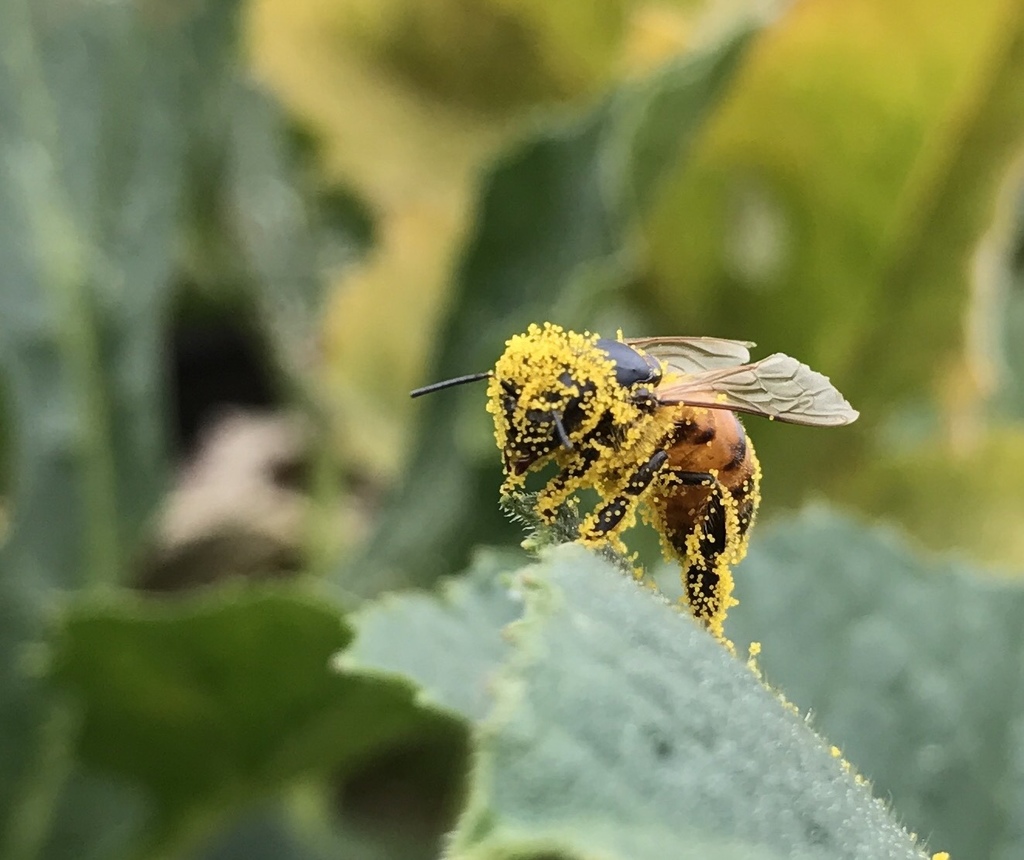
Featured Image: Image Source: (c) Merav Vonshak – some rights reserved (CC BY-NC) via: inaturalist
Primary article: Haque, S., F.Ponton, A. P.Allen, et al. 2026. “Environment and Pollen Diversity Differentially Affect the Gut Microbiomes of Introduced Honeybees and Bumblebees.” Evolutionary Applications19, no. 4: e70234. https://doi.org/10.1111/eva.70234.
Secondary article: Engel, P., Kwong, W. K., McFrederick, Q., Anderson, K. E., Barribeau, S. M., Chandler, J. A., Cornman, R. S., Dainat, J., de Miranda, J. R., Doublet, V., Emery, O., Evans, J. D., Farinelli, L., Flenniken, M. L., Granberg, F., Grasis, J. A., Gauthier, L., Hayer, J., Koch, H., Kocher, S., … Dainat, B. (2016). The Bee Microbiome: Impact on Bee Health and Model for Evolution and Ecology of Host-Microbe Interactions. mBio, 7(2), e02164-15. https://doi.org/10.1128/mBio.02164-15
Bees are an important keystone species that contribute to the biodiversity of the environment that we all depend on. One of the key determining factors of a bee’s survivability in changing environments is strongly correlated to a bee’s gut microbiome. Better understanding how these shifts in the bee gut microbiome occur, and how they affect bee health can help manage biological invasions and control invasive populations of bees.
Invaders are organisms that take over an environment not originally native to and cause significant harm to the environment. Bees are essential pollinators and common invaders around the world. Determining how gut microbiomes respond to environmental changes can be crucial in understanding how some bee species are capable of being successful invaders.
In the study, “Environment and Pollen Diversity Differentially Affect the Gut Microbiomes of Introduced Honeybees and Bumblebees” completed by Haque et al., a type of DNA sequencing called metabarcoding was used to analyze if different pollen and environmental factors contribute to varying gut microbiomes in two bee species: The European honeybee, Apis mellifera, a long-established pollinator, and a recently invasive bumblebee, Bombus terrestris across Tasmania, Australia.
The goal of this study was to look at the core and facultative gut microbiome differences between bee species in relation to pollen type and environmental variables.The core is known as the stable microbiome and forms the foundation of the gut. The facultative microbiome fluctuates depending on diet and is more versatile compared to the core microbiome. Female worker bees A. mellifera and B. terrestris were collected in the summer during peak activity. Bees were collected from flowering plants in open areas across urban, rural, and residential locations.
Male bees were not used in this study as they are not the primary foragers and lack key anatomical features that are correlated with resource collection. The bee species’ DNA was extracted and sequenced to look at what bacterial species were present in the gut of the two species.
To analyze the effects of pollen on the gut microbiome, pollen was removed from each bee. Then, the pollen DNA was amplified through polymerase chain reaction and subsequently sequenced for analysis.
Insightful Findings from the Study
It was found that ten major bacterial families were identified in the gut microbiome of A. mellifera and fifteen in B. terrestris. Both species shared five core genera. From this study, it was concluded that the gut microbiomes of these two species were heavily influenced by local environmental variables and foraged pollen diversity which was concluded based on statistical analysis of the samples gathered from the female worker bees.
Gut Composition and Environmental Correlations
The figure below highlights the data of environmental variable correlations between the two bee species utilizing non-metric multidimensional scaling (NMDS) plots. Close points on an NMDS graph represent samples that are similar in their composition while points far from each other represent samples that are dissimilar in composition. In these particular plots it was of interest to analyze the bacterial gut composition of the two bee species and see if there was any correlation to five different environmental factors: mean annual precipitation (average yearly water) , mean annual temperature, pasture percentage (proportion of high-quality forage plants in a field) and average summer wind velocity. NMDS plot A (top) is looking at the bacterial gut composition of samples from A. mellifera and based on the clustering of the points in the top right there is a correlation with the gut composition being associated with mean annual temperature.
NMDS plot B (bottom) is looking at the bacterial gut composition from B. terrestris the bacterial gut composition was significantly correlated with mean annual precipitation and pasture percentage based on point clustering.

Open in figure viewerPowerPoint
NMDS ordination of gut microbial communities for (A) A. mellifera and (B) B. terrestris across Tasmania, based on Bray–Curtis dissimilarity of ASV abundance. Sample NMDS scores were averaged at the site level and represented graphically using centroids and standard error bars. Stress for both NMDS plots = 0.2. AR, mean annual precipitation (mm); AT, mean annual temperature (°C); PP, percentage of pasture (%); WV, average summer wind velocity (m/s). Refer to Table S6 for summary of environmental vector correlations (envfit; 999 permutations).
Figure and caption from Haque et al., 2026 https://doi.org/10.1111/eva.70234
The Effects of the Environment on the Bee Gut Microbiome
The figure below is two heatmaps looking at the effects of mean annual temperature and wind velocity on overall gut bacterial diversity and mean annual precipitation and wind velocity in B. terrestris. The data from the heatmaps highlights how B. terrestris’ was greatly affected by the mean annual precipitation.

Open in figure viewerPowerPoint
Interaction effects of—(A) wind velocity and temperature on overall gut bacterial diversity of B. terrestris, (B) wind velocity and precipitation on core gut bacterial richness of B. terrestris. Diversity measure = Shannon; Richness measure = Chao1.
Figure and caption from Haque et al., 2026 https://doi.org/10.1111/eva.70234
To summarize, the two bee species differed significantly on facultative gut bacterial diversity, overall bacterial richness, and facultative bacterial richness.
Pollen Diversity and Bee Gut Microbiomes
The figure below is another heatmap comparing the core and facultative diversity of the two bee species when looking at pollen diversity and the different environmental factors. The results of the heatmaps show that pasture and native pollen diversity showed a greater effect on B. terrastis facultative gut microbiome.

Open in figure viewerPowerPoint
Pasture × pollen interactions. (A) Species variation in the interaction effect of pasture and native pollen diversity on facultative gut bacterial diversity. Site abbreviations (A = Apis and B = Bombus) are included alongside site names; (B) Effects of pasture and native pollen diversity on facultative gut bacterial diversity of B. terrestris. (C, D) Species variation in the interaction between pasture and native pollen richness on (C) facultative and (D) overall gut bacterial richness. (E) Species variation in the interaction between pasture and overall pollen richness on facultative gut bacterial richness. In (A–E), circles represent Apis sites and triangles represent Bombus sites; Diversity measure = Shannon; Richness measure = Chao1.
Figure and caption from Haque et al., 2026 https://doi.org/10.1111/eva.70234
Overall, B. terrestris has a more environmentally responsive gut microbiome compared to the long-established pollinator A. mellifera. This can correlate to B. terrestris ability to persist and survive in new environments. This valuable information on the bee gut microbiome highlights the sensitivity of the microbiome and offers a backbone for future studies on bee microbiome monitoring.
How do Gut Microbiomes of Bees Contribute to Environmental Science?
Native bees are the cornerstones for ecosystem stability. Many native bees are pollinator specialists meaning that if the bee is not present to pollinate its specific flower the flower does not reproduce. Native bees are also responsible for pollinating some of the plants we use for food such as pumpkin and squash.
Honey bees are used agriculturally as pollinators along with producing various resources such as honey, beeswax, and royal jelly.
The bee gut microbiome is a crucial factor in affecting host health. Better understanding of the key players in the bee gut microbiome will help better understand how invasive bee species can persist in new environments. It can also aid in the development of tools for habitat restoration, agricultural sustainability, and keep key important pollinators healthy.
Future research could look at using these native traits from the invasive bee species and apply to the native bees to allow for better competition against these bee invaders.
Reviewed by:


