Patching Up the Climate: Forest Continuity, Productivity, and Carbon Sequestration
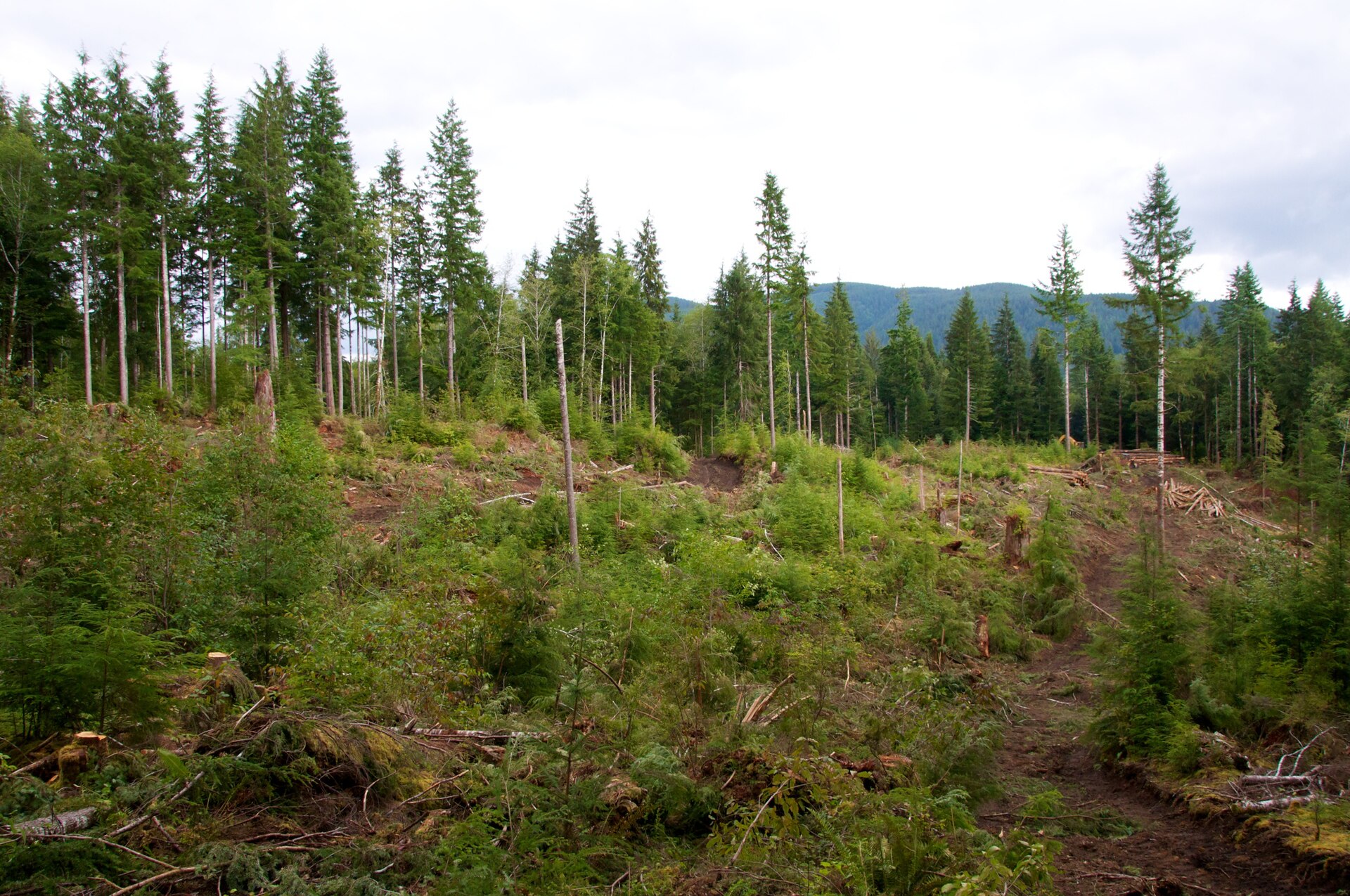
Featured image caption: A cleared space by the edge of a forest patch. (Image source: https://commons.wikimedia.org/wiki/File:Gods_Vally_patch-cut_-_panoramio.jpg by Sam Beebe/Ecotrust is licensed under CC BY-SA 3.0, via Wikimedia Commons.)
Source article: Zou, Y., Smith, G. R., Lauber, T., Wan, J., Ma, H., Gorelick, N., Zohner, C. M., & Crowther, T. W. (2026). Larger forest patches have greater per-area productivity. Nature Ecology & Evolution. https://doi.org/10.1038/s41559-026-03075-5
Forests are a critical resource for carbon sequestration, essential for mitigating the effects of climate change. When plants perform photosynthesis, they take carbon dioxide gas and combine it with water and sunlight to create glucose and oxygen. The carbon from the gas is “stored” in the chemical structure of the glucose and becomes part of the plant’s biomass. In this way, forests full of plants can serve as large, natural “carbon sinks.” Since the carbon is within the plants, it isn’t in the atmosphere forming carbon dioxide or other greenhouse gases, which limits their warming effects.
Currently, forests absorb about a quarter of human carbon emissions each year. Deforestation threatens this service, not only by reducing total forest cover, but by fragmenting forests into isolated patches. Compared to contiguous forest, fragments tend to support fewer species due to habitat loss. In addition, smaller fragments have more of their limited range bordering on areas with different ecotypes, creating “edge effects” specific to these boundary zones. These can include substantial differences in temperature and exposure to light or wind, often detrimental to forest inhabitants that are better adapted to the conditions of more contiguous habitat. The broader risk is a scenario where although some forest cover appears to persist, biomass is in decline.
The gap between continuous forests and fragmented patches has direct relevance for conservation policy, which tends to focus on total forest area. Total area approaches assume that isolated patches are effectively the same as a contiguous area of equal size within a larger forest. As a result, policymakers may overlook carbon losses tied to forest fragmentation despite meeting overall targets for conserved areas.
The Relationship Between Patch Size and Productivity
To address this gap between observation and policy, Zou et al. (2026) sought to quantify the productivity of forest patches. Note that in this context, “productivity” means plants doing photosynthesis, which gets carbon out of the air. The study examined nearly 17 million patches of varying sizes across the lower 48 US states, totaling slightly under 1.5 million kilometers.
Productivity was modeled as a function of patch size, while controlling for spatial autocorrelation (whether patches in close geographic proximity are more likely to be similar), as well as local environmental factors. If fragmentation doesn’t matter, then the relationship between patch size and productivity should be roughly linear. The relationship turned out to be “superlinear,” meaning that productivity goes up more than proportionally with patch size, and spatial autocorrelation was minimal.
Counterfactual Context
So fragmentation matters, but how much, exactly? Zou et al. clarified further by comparing the amount of fragmentation they observed to possible alternative scenarios. They modeled three options, holding the total forest area constant in each: 1) realized configuration, referring to the actual empirical dataset; 2) least fragmented, imagining that every patch has the per-area productivity of the most productive patch in the dataset; 3) most fragmented, instead treating everything like the least productive patch.
Compared to the least fragmented scenario, the realized configuration had 14% lower total productivity, while the most fragmented scenario shows a 28% drop in productivity. These findings indicate substantial losses from fragmentation, but also imply that restoring the continuity of forests could improve carbon storage even without increasing overall area.
Patch Predictive Power
How well does patch size predict forest productivity compared to other environmental variables? Zou et al. used the coincidentally named “random forest” machine learning approach to find out. Essentially, an algorithm builds a “forest” of decision trees, with each tree trained on a different, random, piece of a dataset. Each tree makes a prediction based on the data it has, then the trees settle on a result via majority vote.
Two random forest models were designed, one including patch size as a predictor and one without, otherwise using the same set of covariates with productivity as the response variable. The model with patch size was a better predictor than the model without patch size, further underscoring its relevance.
Going a step further, the importance of each variable in a random forest model can be ranked. When patch size was included, it came third, behind temperature and precipitation, but ahead of soil conditions and topology. So patch size isn’t the single most important thing, but it’s certainly up there, and definitely overlooked!
Trends Around the World
Having established the baseline expectation in the US, Zou et al. extended their models to forest patches across the globe. They found the positive relationship between patch size and productivity to be stronger on continents with tropical forests, including Oceania, Africa, South America, and Asia. For North America and Europe, hosting more temperate forests, the relationship was present but weaker, or in Europe’s case, slightly negative. Overall the trend held up, but further research is needed to explore what factors other than fragmentation drive the exceptions.
Takeaways for the Next Policy Meeting
Simply focusing on total forest area, or even planting a lot of trees to make up for losses elsewhere, is missing the full story. To maximize carbon sequestration, we need contiguous forests: to preserve those not yet dismantled, and to reconnect isolated patches where feasible.
In addition, while we’ve identified a global trend, it’s clear that the specifics vary at local or regional scales. What’s healthy for a forest in North America may differ substantially from a forest in Oceania. We will need to synthesize information on forest health across scales to best inform our conservation practices.
Reviewed by: