
Wildfires leave long-lasting impacts on water quality in the Western U.S.
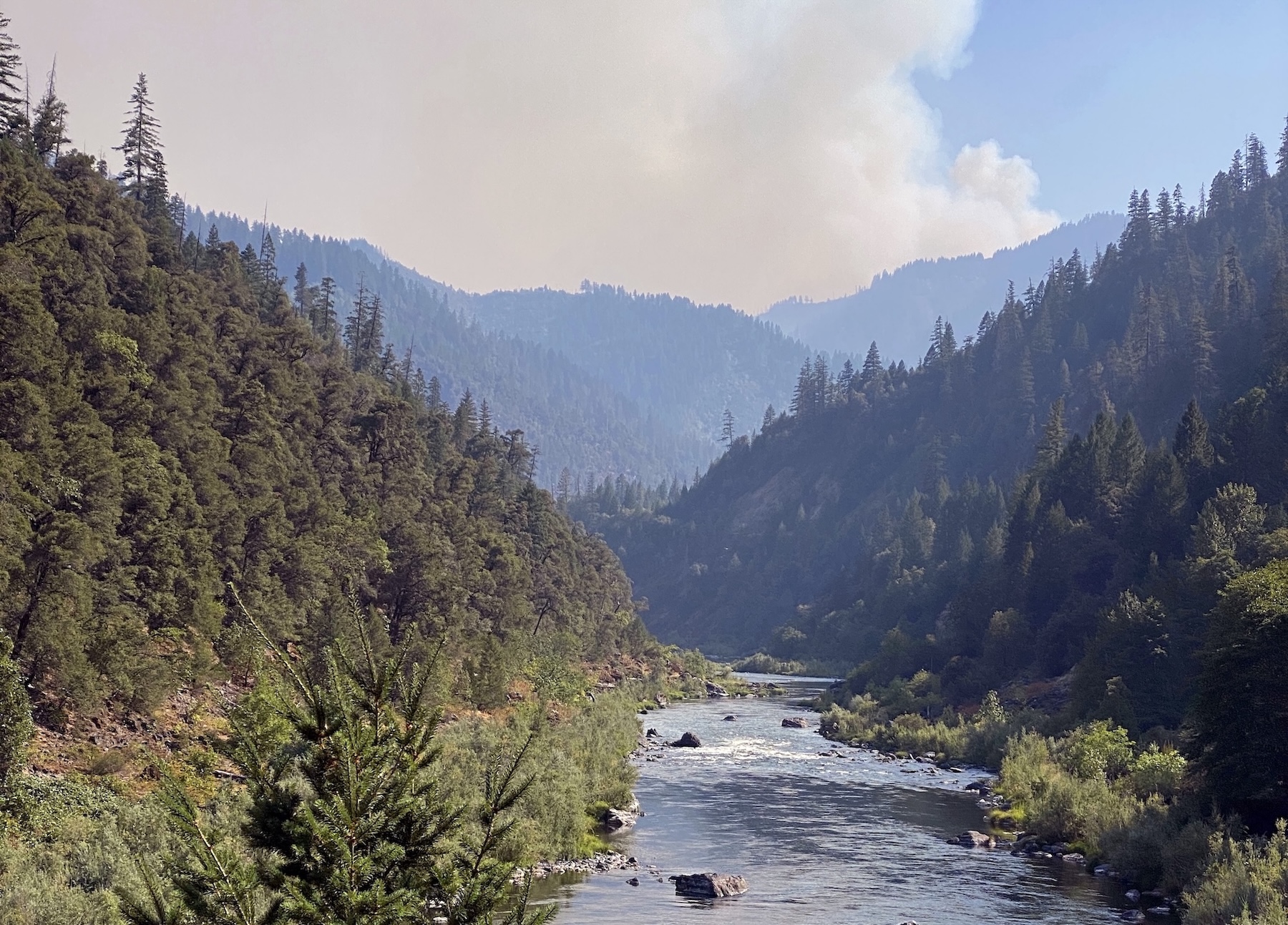
Featured image caption: Smoke from the McCash Fire in 2021 hangs over the Klamath River in northern California. Fires impact water quality both at long-distances through ash deposits and at close range by charring vegetation and destabilizing soils. (Image source: ‘McCash Fire and Klamath River August 25 2021’ by Geoff Liesik of the Bureau of Land Management, CC-PD-Mark, via Wikimedia Commons)
Source article: Brucker, C.P., Livneh, B., Rosario-Ortiz, F.L. et al. Wildfires drive multi-year water quality degradation over the western United States. Commun Earth Environ 6, 489 (2025). https://doi.org/10.1038/s43247-025-02427-6
When the smoke clears, the water doesn’t
When wildfires rip through the landscape, the devastation they leave behind is visible – scorched trees, charred structures, and smoky skies can haunt an area for months. But there’s another, less obvious impact that can linger for years: polluted water.
A new study published in Nature Communications Earth & Environment reveals just how long-lasting and widespread wildfire-related water quality problems can be. A team of hydrologists and engineers analyzed nearly 50 years of water quality data from across the western United States and found that wildfires can trigger dramatic and persistent increases in harmful water contaminants which poses challenges for ecosystems, drinking water utilities, and public health.
Wildfires have long-lasting effects beyond surface-level destruction. Near recently burned areas, waterways frequently experience contamination from fine soil particles and organic matter. These burned soils are dry, water-repellent, and prone to erosion from the lack of living plant roots, increasing the amount of runoff full of fine particles, ash, and compounds that leach from the burned soils. When these contaminants enter waterways, their effects are far-reaching.
The total land area that channels water into a river or lake is known as a watershed; fires within a watershed impact all of the downstream recipients including creeks, tributaries, rivers, lakes, and oceans. In addition to the wild flora and fauna that depend on natural water sources, many cities also rely on forested watersheds for drinking water. Fires can destroy that vegetation, degrade the soil, and completely change the quality of water reaching the city’s treatment plants and neighborhoods. While we know fires contaminate local watersheds, each burn site is different and the severity of the water pollution can vary widely. It’s hard to compare the effects of fires between the Rocky Mountains and the deserts of the Southwest because the landscapes and vegetation are so different, and fires vary in area and intensity. This new study aims to uncover overall trends in water quality on a much larger scale.
Watching western watersheds: a large-scale analysis of water quality after fire
A team of researchers led by Dr. Carli Brucker at the University of Colorado Boulder analyzed large-scale, long-term trends in water quality in response to fires. The researchers considered more than 500 different watersheds across the western United States, spanning sites from southern California to northern Montana. They analyzed over 200,000 water quality data points over a period of nearly 50 years from 1974 to 2022. These data tracked changes in key water quality indicators: organic carbon, nitrogen, phosphorus, sediment, and turbidity (a measure of water cloudiness).

The researchers built a model to measure how drastically these factors change pre- and post-wildfire, which allowed them to isolate the “big picture” of how contaminants respond over time and across diverse landscapes. In the model, they controlled for climatic effects on water quality to isolate how fire itself was changing these pollution factors independent of local climate and hydrology factors like temperature, precipitation, fire season timing, and typical runoff.
The team discovered three key results about water quality post-burn at this scale. First, across sites, there are generally spikes in contaminants. For sites across the region in the first two years after a wildfire, total carbon increased by 462%, nitrogen and phosphorus increased 224%, suspended sediments increased 254%, and turbidity shot up a whopping 4420%. At a large scale, this suggests that severe water quality degradation is common after fires.
Second, not all sites respond the same way. Watersheds with either more forested area or more developed land showed larger spikes in contaminants, suggesting that landscape characteristics play a big role in how water systems respond to fire. Forested areas likely showed large increases in carbon, nitrogen, and sediments because they have higher fuel loads in the trees and shrub understories that contribute ash, organic matter, and nutrients to the burned area. In developed areas, they might show elevated nutrient and sediment levels due to higher atmospheric deposition from the burning of fossil fuels and from high cover of concrete and asphalt surfaces increasing runoff.
Third, these impacts last multiple years. While most other studies only have the data to evaluate short-term effects (2-3 years), this analysis considered longer-term outcomes. While the data used here included nearly 50 years of water sample data from 1974-2022, the longest consecutive sampling series at a single site only covered 8 years. Post-burn, elevated levels of organic carbon, nitrogen, sediment, and turbidity persisted for these 8 documented years, and likely could last for decades.

Without mitigation, clean water could go up in smoke
Many cities depend on forested watersheds for their drinking water. Wildfires strip away vegetation, destabilize soil, and alter how water flows through the landscape. That means more debris, nutrients, and pollutants get washed into rivers and reservoirs. This soil instability creates a positive feedback loop that makes it harder for vegetation to re-establish and return the waterway back to normal. Increased nutrients and organic matter entering waterways can also fuel harmful algal blooms, stress aquatic life, and lead to violations of water quality standards for nearby neighborhoods. Targeted restoration efforts and erosion control in recently burned areas may help reduce nutrient-rich runoff and turbidity downstream and promote more natural water filtration.
Findings from this study offer critical insights for water utilities, land managers, and emergency planners. For instance, water treatment systems may need to prepare for multiple years of elevated contaminant loads after a wildfire. Management should also consider local geographical and biological features, since watersheds with more trees or nearby development are more vulnerable to severe water quality degradation. Short-term fixes like boosting filtration capacity can help, but long-term planning could also include forest management practices and buffer zones to reduce burn severity, as well as sediment traps to mitigate damage downstream.
As wildfires continue to shape western landscapes, our water systems must adapt. This research offers a roadmap for assessing and managing the long-lasting consequences fires leave in their wake. Wildfires may come and go in a matter of days, but their impacts echo through our water infrastructure for years. Without the proper fire season preparation, clean water may be one more thing going up in smoke.
Reviewed by Cypress Novick




.jpg)
.jpg)