
Alarms but Also Hope: A Review on Ocean Stratification
Source Article: Cheng, L., Li, G., Long, S., Li, Y., Von Schuckmann, K., Trenberth, K. E., Mann, M. E., Abraham, J., Du, Y., Cheng, X., Liu, H., Xu, Z., Liu, M., Peng, Q., Gong, X., Ma, Z., & Yuan, H. (2025). Ocean stratification in a warming climate. Nature Reviews Earth & Environment, 6(10), 637–655.
https://doi.org/10.1038/s43017-025-00715-5
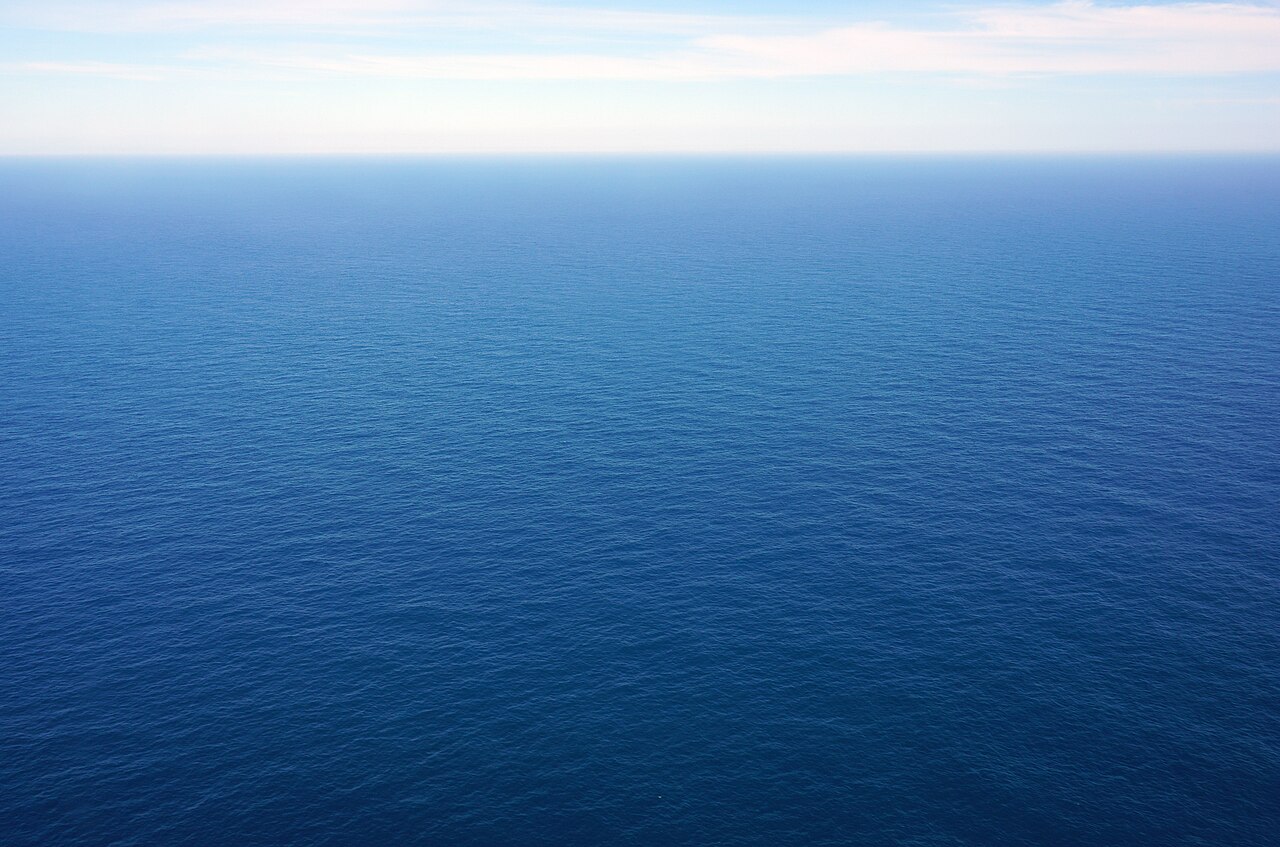
Featured Image Caption: water covers almost three-quarters of our planet’s surface, mostly in oceans. Its many and complex contributions have been severely affected as of late, leading the most massive and essential water bodies to segregation. (Atlantic near Faroe Islands seen from helicopter by kallerna is licensed under CC BY-SA 4.0, via Wikimedia Commons)
Water is a hard requirement for life as we know it and represents a relevant biomarker even when astronomers explore other planets, in and out of our solar system. As such, it is a fundamental premise to terrestrial (or extraterrestrial) existence, but also much more than that. Water is responsible for establishing and maintaining the necessary conditions for life to be a long-running, sustainable endeavor.
In Earth’s case, its many contributions roll out from an imposing presence covering almost three-quarters of the global surface, mostly in oceans. And while science has made remarkable progress in understanding the delicate framework these massive water bodies set and operate in, there are still critical aspects waiting for further investigation.
One of these, commonly referred to as ocean stratification, has been discussed in a recent review on the topic, published in Nature. Specifically, researchers first summed up everything there is to know on the matter and then shared observed and projected stratification trends in a warming climate, describing the related consequences.
But before diving into the study, what is ocean stratification, and why does it matter?
Divide and Control
In our everyday lives, we see objects rise and sink in water. It is a natural phenomenon that occurs when there is a difference in density between whatever is immersed in liquid and the liquid itself. What might seem unusual, though, is to think that this could also happen when nothing but water is present.
If you take the ocean, for instance, and imagine a water column, some parts of it may be warmer or fresher than others and consequently less dense (given that, in such conditions, particles may travel further away from each other or lower salt amounts might be present, leading to less packed spaces). Then, based on our experience, we would expect these same parts to follow some kind of vertical motion. In this case, a rise. And that is exactly what we observe, along with an effective separation between two distinct layers.

Normally, these processes occur on scales much larger than what briefly seen here and lead to stratifications that can be more or less complex. But once a stable condition is reached, this ensemble of layers acts as a veritable barrier against further movements up or down the column.
To assess how strong this particular effect is, researchers rely on the squared value of a quantity known as the buoyancy frequency, indicated as N2, and representing the reluctance of particles to engage in vertical motion when temperature or salinity differences exist in water.
The more abrupt these changes become with depth, the higher the buoyancy frequency and the less movement can occur, effectively rendering the barriers more impenetrable.
In this sense, intense stratification, which plays a major role in controlling essential flows with the atmosphere and within oceans themselves, might induce severe disruptions in ecological balances as well as planetary responses to climate perturbations. And, unfortunately, global warming has had dramatic effects on both of these aspects, impacting the strength of oceanic barriers.
Warmer Air Makes for Segregated Water
A team of 17 researchers, from various academic institutions around the world, produced two groups of results in their review: one observational, involving measurements on ocean temperature and salinity performed between 1960 and 2024, and the other simulated, relying on projections from climate models under different greenhouse gas emission scenarios and up until 2100.
In each set, the team focused on the retrieval of a representative N2 value for every year in the time series, at both near-surface and deeper water depth ranges. Once researchers obtained these buoyancy frequencies, they tracked the associated stratification shifts occurring over the whole 1960-2100 period and then estimated the magnitude and direction of trends in the data.
For what concerns results retrieved in the near-surface depth range (that is 0 – 200m), the team discovered a 1.1% increase per decade in global stratification throughout the observational group, followed by simulations that contrasted a stabilization, in low emission conditions, to 0.4% by 2100, with a sharp swell to 1.3% and 3.1% instead for moderate to high emission scenarios, respectively
Similarly, from analyses of the deeper water depth range (corresponding to 0 – 2000m), researchers noticed a 0.8% increase per decade in global stratification from 1960 to 2024. Then, projections to later times showed a stabilization to 0.7%, along with a rise to 1.4% and 2.9% by 2100 in low, moderate and high emission scenarios, respectively. Not altogether different from the near-surface case, were it not for the lower figures obtained, reflecting the inclusion, with larger depth ranges, of bottom ocean dynamics and responses, slower than their upper-layer counterparts in picking up shifts in environmental conditions.
And on this specific note, it became quickly evident to the team, digging into potential causes of these worrying changes, that most of the observed trends were predominantly driven by rising air temperatures, warming near-surface waters and exacerbating the gap with deep oceanic environments, in turn leading to higher buoyancy frequencies and more intense stratification, even when salt concentrations sometimes acted, at regional levels, in opposition to the shifts.
Severed Connections
Behind what might look like fairly modest changes, which, anyway, seem to be accelerating towards higher values, global warming effects on ocean stratification hide cascading consequences that reach far and wide.
The increasing impenetrability of oceans with respect to flows through them, cuts fundamental connections that, under standard conditions, would ensure the operation of a well-balanced climate system, but that nowadays have also turned into essential means of survival against anthropogenic perturbations.
Instances in which intense ocean stratification becomes critical might be carbon and heat exchange processes, being prevented from ever reaching bottom waters and thus piling up in near-surface layers (with no other way to go but back up in the air). Other such examples could be oxygen flow stuck at shallow depths and interrupted nutrient supply chains, threatening the existence of the marine biosphere in its entirety (along with ours too). And many more, feeding on each other in feedback loops of rising severity. And yet, there might be something we can do.
The low greenhouse gas emission scenario seems like a promising route to take. At the very least, results from climate models tell us that there is a possibility to stabilize ocean stratification and stop it from increasing to intolerable levels in the following years. It is by no means a guaranteed outcome, especially with the way things are currently going, but maybe a small hope and some luck is all we really need to turn things around.
Reviewed by:


