
A Warming Planet Could Increase the Risk of Infectious Diseases Spilling Over from Animals to Humans
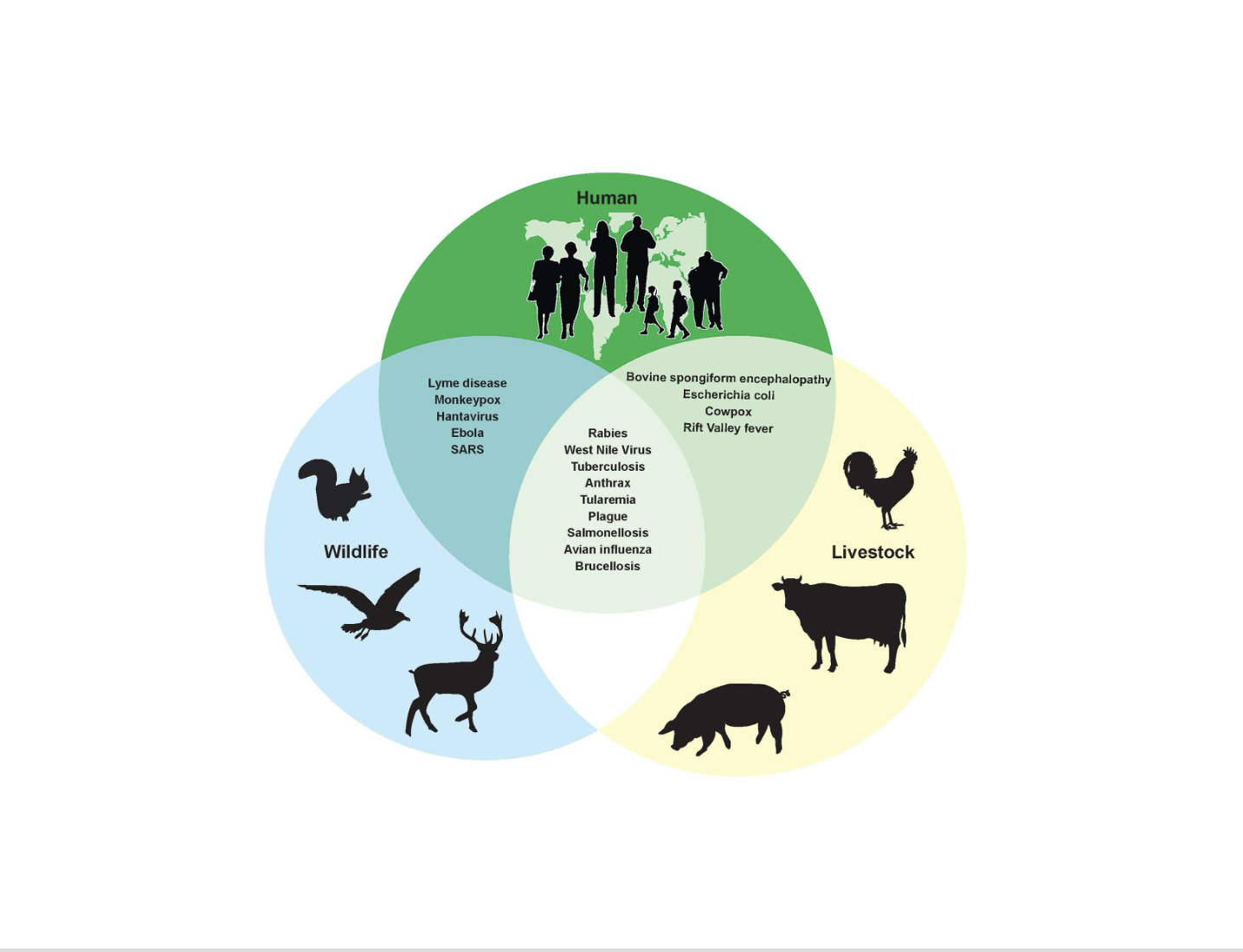
Featured image caption: Select zoonotic diseases that humans can catch from wildlife and/or livestock. (Image source: “Examples of Zoonotic Diseases and Their Affected Populations,” U.S. Government Accountability Office from Washington, DC, United States, Public domain, via Wikimedia Commons).
Source article: Trebski, A., Gourlay, L., Gibb, R., Imirzian, N., & Redding, D. W. (2025). Climate sensitivity is widely but unevenly spread across zoonotic diseases. Proceedings of the National Academy of Sciences, 122(50), e2422851122. https://doi.org/10.1073/pnas.2422851122
Zoonotic diseases, which pass from vertebrate animal reservoirs to humans, can trigger catastrophic outbreaks, as seen with the COVID-19 pandemic. It is vital to understand the factors influencing the burden of zoonotic disease to predict future disease risk and protect public health.
One factor that may play an important role in zoonotic disease risk – but is still not fully understood – is climate change. Changes in temperature, precipitation, and humidity due to climate change can affect how diseases spread (Table 1, Trebski et al. 2025). For example, in mosquito-borne zoonotic diseases, such as West Nile virus, increased precipitation can create more standing water where mosquitoes breed. Temperature and humidity also affect how long mosquitoes survive and how often they bite, ultimately driving changes in disease transmission. Human behavior is also influenced by climatic factors. For example, people are more likely to open windows and spend time outside in warmer weather, which can increase their chances of encountering mosquitoes and consequently their risk of catching mosquito-borne diseases.
In a recent study published in PNAS, researchers set out to test how climatic factors are linked to indicators of zoonotic disease risk, such as disease case counts and pathogen abundance. The researchers conducted a comprehensive literature review and identified 218 studies describing the relationship between climatic factors and zoonotic risk in 65 countries.

These 218 studies examined 53 zoonotic diseases, including those caused by bacteria, viruses, and parasites, both vector-borne and non-vector-borne. Vectored diseases are those transmitted from animals to humans through an intermediate carrier, such as a mosquito. In contrast, non-vector-borne diseases are transmitted directly from animals to humans, or indirectly through environmental sources such as contaminated water. Among the diseases most frequently examined in the literature search were West Nile Virus, hemorrhagic fever with renal syndrome, and leptospirosis.
Climate change is predicted to have widespread but variable effects on zoonotic disease risk
The majority of studies found that zoonotic disease risk was sensitive to changes in climate, but not all diseases were predicted to respond in the same way. Changes in rainfall, for example, were found to increase risk in 37.8% of records and decrease risk in 25.7% of records, while humidity showed no significant relationship with climatic factors in nearly half (46.4%) of the records.
The effects of temperature were more consistent, with many diseases predicted to show increased risk as temperatures rise. This effect was especially pronounced for vector-borne diseases, with 56% predicted to show increased risk as temperatures rise. Vector-borne diseases may be particularly sensitive to temperature because of multiple temperature-dependent steps in transmission – for example, mosquito-borne diseases typically peak around the warm, rainy season, when conditions promote breeding.1

This study represents an important step toward understanding how zoonotic disease risk will change over the coming decades as the climate continues to change. However, more work is needed to build a more complete picture of future zoonotic disease risk. While this study reviews over 50 diseases, these represent only a fraction of known zoonotic diseases.2
One key takeaway from this review is that the effects of climate change on disease risk vary widely in both strength and direction. Zoonotic diseases result from a complex interplay of animal reservoirs and often arthropod vectors, such as mosquitoes, ticks, or fleas. This complexity makes them difficult to fully understand and predict. Still, studies like this help us move closer to anticipating future zoonotic threats and may eventually allow scientists to forecast outbreaks, enabling better protection of public health.
Protecting yourself from zoonotic diseases
Zoonotic disease risk may be changing with climate change, but you can take steps to lower your risk. The CDC provides some simple tips to protect yourself, such as washing your hands after being around animals and preventing bites from mosquitoes and ticks.3
Secondary sources:
1. Alcayna, T., Rao, V. B., & Lowe, R. (2025). Identifying the climate sensitivity of infectious diseases: a conceptual framework. The Lancet Planetary Health, 9(8), 1-12.
2. Woolhouse, M. E., & Gowtage-Sequeria, S. (2005). Host range and emerging and reemerging pathogens. Emerging infectious diseases, 11(12), 1842-1847.
3. CDC. (2025, April 7). About Zoonotic Diseases. One Health. https://www.cdc.gov/one-health/about/about-zoonotic-diseases.html
Reviewed by:


