
Wolf (and Cougar) at the Door: Restoring Predators in the Eastern U.S.
Source article: Ghasemi, B, Bruskotter, J. T., Vucetich, J. A., Elbroch, L. M., Wilson, R. S., Carter, N. H., Moehrenschlager, A., Perry, S., Hinton, J. W. (2026). Restoring the wild east: Predicting public support for cougar and red wolf reintroduction in the eastern United States. Biological Conservation, 313, 111532. https://doi.org/10.1016/j.biocon.2025.111532.
Secondary articles:
Elbroch LM, Wittmer HU. Table scraps: inter-trophic food provisioning by pumas. Biol Lett. 2012 Oct 23;8(5):776-9. doi: 10.1098/rsbl.2012.0423. Epub 2012 Jun 13. PMID: 22696284; PMCID: PMC3440996.
Glass, T. W., Beausoleil, R. A., Elbroch, L. M., Kertson, B. N., Maletzke, B. T., Martins, Q., Matchett, M. R., Vickers, T. W., Wilmers, C. C., Wittmer, H. U., & Robinson, H. (2024). Limited cougar recolonization of eastern North America predicted by an individual-based model. Biological Conservation, 298, 110756.https://doi.org/10.1016/j.biocon.2024.110756
Murray, A., Sutherland, R. and Kays, R. (2024), Ecological effects of a declining red wolf population. Anim. Conserv., 27: 396-407. https://doi-org/10.1111/acv.12919
Serota, M.W., Barker, K.J., Gigliotti, L.C. et al. Incorporating human dimensions is associated with better wildlife translocation outcomes. Nat Commun 14, 2119 (2023). https://doi-org/10.1038/s41467-023-37534-5
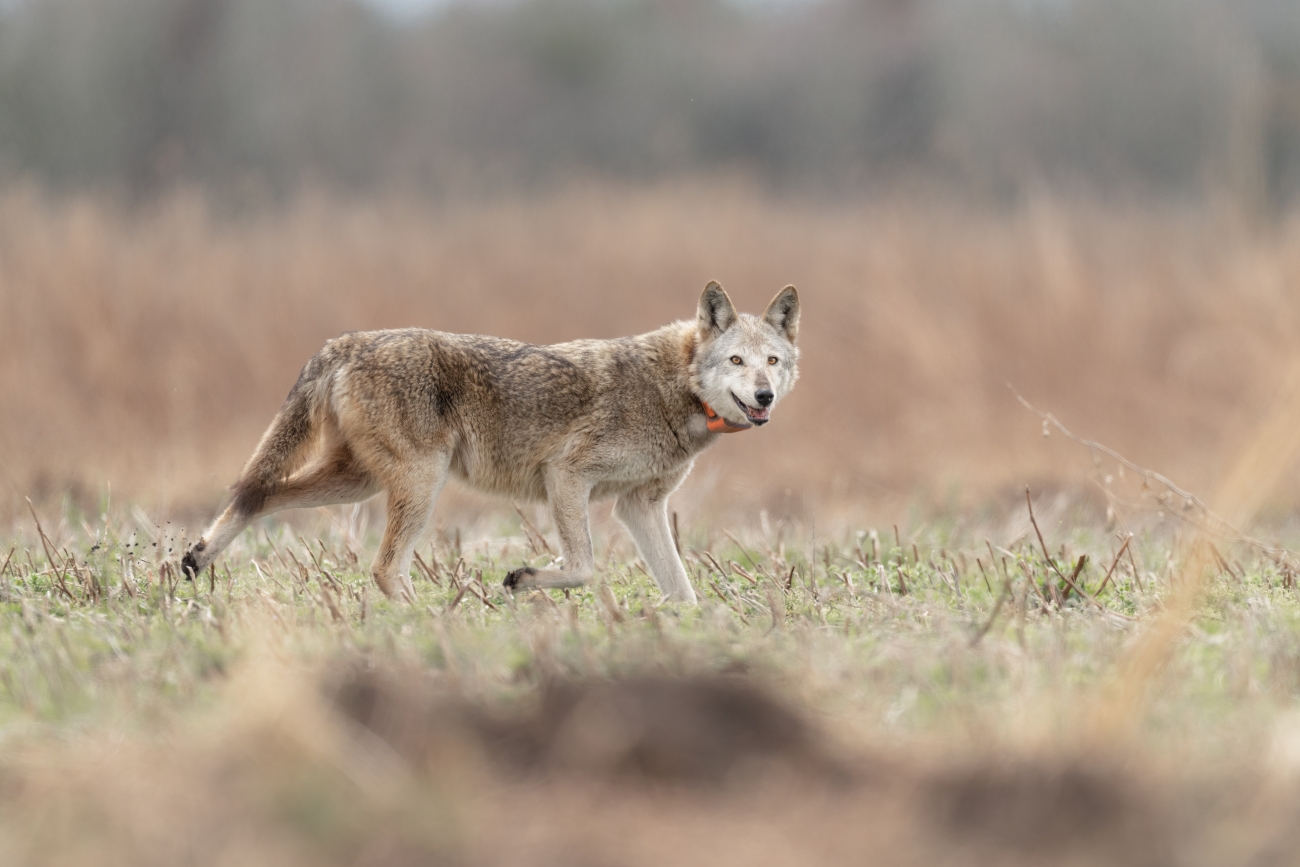
Featured image caption: Thirteen-year-old female red wolf 1743 crosses a field in the Alligator River National Wildlife Refuge in North Carolina, home to the only wild red wolf population. (Jennifer Hadley/USFWS Public Domain)
Room to Roam
Cougars (or mountain lions) and red wolves once roamed the Eastern United States, providing food sources for smaller species and shaping the ecosystems in which they lived. Then in the 1800s, European settlers in America waged a one-sided war against predators, eradicating both species from their Eastern range.
Today, America’s cougars are found in the West, with one breeding population of Florida panthers persisting in the Everglades. The only wild red wolves were reintroduced to a wildlife refuge on a remote peninsula off the coast of North Carolina and number about 30 individuals. Deadly highways have prevented both species from expanding their ranges without human intervention.

As knowledge of carnivores’ ecological importance grows, conservationists are increasingly joining a ‘rewilding’ movement – yet would wildlife managers have the social license to bring back these large predators to Eastern states?
Researchers led by Benjamin Ghasemi from Ohio State University surveyed Eastern U.S. residents to understand the social side of bringing back the wild predators.
Components of Coexistence
When reintroducing wildlife, social acceptance by local communities can be just as significant as habitat features in determining success. Therefore, understanding how people think and feel about new wild neighbors is critical for management.
Ghasemi and coauthors used the hazard acceptance model to evaluate people’s attitudes toward reintroducing the carnivores. The model predicts individuals will side for or against rewilding based on their perceived risk from carnivores, perceived benefits of living alongside carnivores, control over potential risk, affect (or emotional response associated with a species), and trust in their local wildlife management agency.
Each model component can influence human attitudes toward carnivores. For example, individuals with high trust in agencies – owing to perceived capability or shared values – may have lower risk perceptions and increased benefit perceptions, while people who feel unable to control their exposure to negative carnivore encounters are likely to oppose conservation efforts.
In this survey, risks included carnivores preying on livestock or harming people, while benefits included positive ecological, intrinsic, and economic outcomes. Researchers asked Eastern U.S. residents about perceived personal and social risks and benefits.
Won’t You Be My Neighbor?
For both cougars (2665 respondents) and red wolves (3825 respondents), Eastern U.S. residents broadly indicated support for reintroduction.

The study found support for rewilding increased with perceived personal and social benefits and decreased when respondents perceived social risks. Personal risk significantly reduced support for rewilding cougars, but not red wolves.
In turn, perceived control predicted how respondents perceived personal and social impacts, with lower control linked to higher risk and lower benefit perceptions. For both species, trust in management agencies did not have an overall significant effect on reintroduction support.
Positive affect directly boosted reintroduction support for both species and was associated with increased perceptions of benefits and lower risk perceptions.
Overall, predicted model relationships regarding risk, benefit, affect, and perceived control were strongly supported, while personal risk and agency trust had weaker or less consistent effects.
Drawing on Human Dimensions
The authors argue these study findings will better inform managers in the East who create wildlife recovery, conflict management, and outreach strategies to bring back cougars and red wolves.
Since affect influenced rewilding support, the authors suggest managers create emotional connections between the public and large carnivores, such as fostering empathy through storytelling and pointing out the ecological, cultural and monetary benefits the species can provide.
To minimize risk and enhance perceived behavioral control, managers should also inform people about their actual level of risk and what they can do to manage it, such as by penning livestock or keeping dogs on-leash when hiking, while also discussing benefits for the strongest effect. Where trust in agencies is lower, conservationists may seek another trusted, credible source to deliver the message.
Authors also noted that public engagement plans should be targeted to address the individual species as well as specific audiences who may have particular values and risk perceptions.
“Ultimately, by understanding and addressing these human dimensions, wildlife managers can design more effective and inclusive conservation initiatives, fostering coexistence and resilience within human-dominated landscapes.” – Ghasemi et al., 2026
Large carnivores require community support to reclaim their former homelands; this study provides both knowledge and recommendations that move cougars and red wolves one step closer to placing paws on Eastern soil.
Reviewed by:

