
Black Bears Play ‘Top Dog’ Role in Some Ecosystems
Source article: Nettles, J. M., C. M. Abramowitz, W. W. Boone, et al. 2025. “ The American Black Bear (Ursus americanus) as an Apex Predator: Investigating the Ecological Role of the World’s Most Abundant Large Carnivore.” Mammal Review e70014. https://doi.org/10.1111/mam.70014.
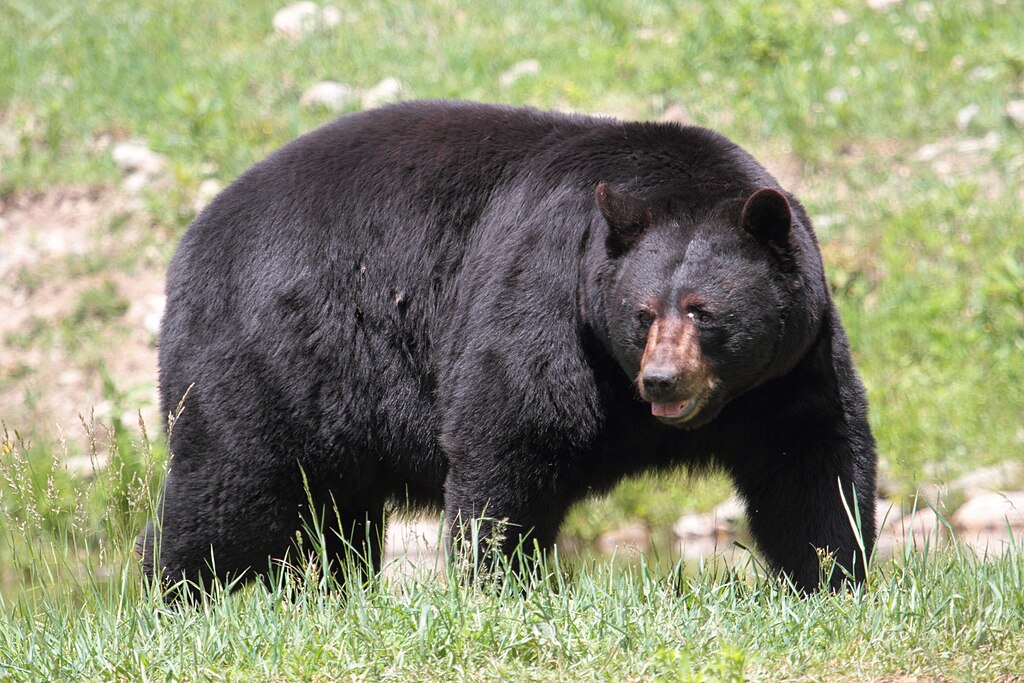
Featured image caption: An American black bear (Ursus americanus) in Quebec, Canada. Photo by
Cephas via Creative Commons Attribution-Share Alike 3.0 Unported
As the world’s most abundant large carnivore, the American black bear (Ursus americanus) plays a major role in food webs across its natural range. Emerging evidence shows these adaptable animals can act as “apex predators,” where they shape the abundance and density of local herbivores and affect the populations or behavior of other carnivores.
But are black bears always “top dog,” or as researchers predicted, might context play a key role in different habitats and around different carnivore species?
Researchers from Clemson University conducted a literature review and analysis to discover when, where, and how often black bears have strong “top-down” trophic (food web) effects on other wildlife. In the process, they raised the question of whether an “apex predator” exists at all.
A Toothy Review: Bear Impacts
Basing the search on previous literature, researchers looked for a suite of potential ways bears could shape other species in the ecosystem, such as affecting the survival, body condition, or space use of prey animals, the behavior of prey and other predators, and (nitrogen cycling/ activity periods). Ultimately, the team analyzed over 200 studies.
They also compared black bear effects in areas where they were the only carnivores to places with different combinations of predators, including pumas or mountain lions (Puma concolor), grey wolves (Canis lupus), and brown bears (Ursus arctos).
In addition, they assessed trends and biases in how the studies were designed and suggested areas for future research.
Hungry as a Bear: Effects on Prey
Overall, researchers found black bears affected prey populations as much as or more than other large carnivores considered to be “apex” predators. In some areas, they were the main predator of juvenile ungulates (hoofed animals).
However, as predicted by the study team, black bears had stronger effects on prey populations when they were the only large carnivore in a system. The presence of pumas, wolves, or both predators had a strong negative effect on black bears’ share of juvenile ungulate mortality.
It’s All Relative: Effects on Carnivores
Researchers investigated how black bears affect other carnivores, including whether they displace other large carnivores in space or time or change their feeding habits.
Notably, only 16 of the 205 analyzed papers looked at how black bears affect other carnivores. Most of these papers studied behavioral effects, such as kleptoparasitism (stealing food from other animals) and scavenging. Only one researched how black bears affect the population density of another carnivore: In that study, high densities of black bears predicted lower densities of brown bears.
Black bear kleptoparasitism and scavenging had consistently negative effects on other predators from many species, including weasels, birds, and skunks. When black bears take over a carcass, they can reduce the feeding time of other carnivores fourfold and prevent smaller carnivores from accessing the food at all. These strong “top-down” effects could impact local carnivore populations.
In particular, black bears consistently had negative effects on pumas by taking over carcasses, reducing their feeding time and forcing an increase in their kill rates.

This finding raises an interesting point about how black bear predation rates of young ungulates drop where other carnivores are present. While more predators can mean less food to go around, black bears may also choose to hunt less and steal more where pumas are present. However, this finding did not hold for wolves or brown bears.
In the end, results were again mixed. Most studies showed black bears negatively affected the behavior of other carnivores, but some showed positive spatial or temporal (time-based) associations with other carnivores.
Wolves and black bears have a complex relationship: Wolves can displace and even kill black bears, who in turn can also drive wolves off kills. The team explained research suggests the two species must balance the benefits of high-quality habitat with the risks of potentially harmful interactions.
What it Means to be ‘Apex’
Overall, researchers found that black bears can dominate both prey and other predators, but these top-down effects are highly context-dependent.
Various factors, including the site, species present, and human influence, determine how strong a predator’s effects are on the ecosystem they live in. The authors proposed a shift in how we define a predator as “apex,” from a uniform status that a species holds across its range to a conditional state that different predators can occupy in different places.
In addition, the authors’ literature search revealed very few experimental studies, which involved manipulating black bears (such as by killing, moving, or feeding bears) or taking advantage of natural experiments (such as comparing the behavior of other species during times of black bear activity with bear hibernation periods).
Moving forward, the authors suggest conducting more experimental studies and examining the effects of black bears on other carnivore populations, not just behavior.

Conservationists need to understand more about how habitat, humans, and other carnivores influence predators’ ability to shape ecosystem function.
For example, as pumas and wolves recolonize some of their historic ranges, they will likely change black bears’ diet and role in local ecosystems.
The authors also proposed exploring how human factors change bears’ trophic roles, like whether bears in urban environments have less influence on natural prey populations.
Learning about when a species meets “apex” conditions can help managers maintain or restore ecosystem integrity.
Reviewed by:

