
Infecting robot locusts with pathogens to study social immunity
Source Article: Romano, D, Stefanini, C (2025). Investigating Social Immunity in Swarming Locusts via a Triple Animal–Robot–Pathogen Hybrid Interaction. Advanced Intelligent Systems 2400763. https://doi.org/10.1002/aisy.202400763
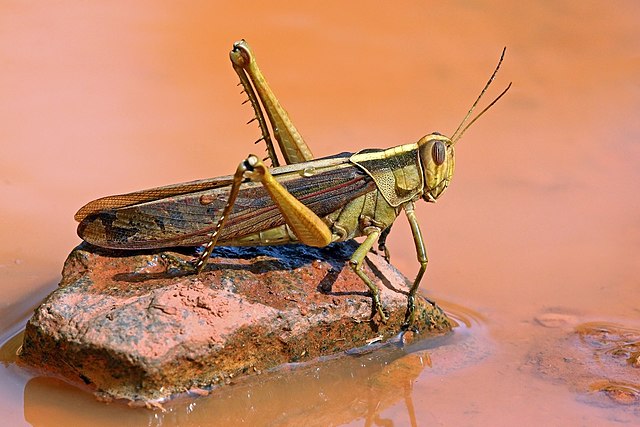
Featured Image Caption: Locusts are an important model organism, as they display interesting social behaviors and are agricultural pests (Image source: “Garden locust (Acanthacris ruficornis), Ghana“ by Charles J. Sharp, CC Attribution-Share Alike 4.0, via Wikimedia Commons).
Living in a group presents unique challenges to animals. Social organisms have to navigate a vast range of interactions with other group members and with their external environment. For instance, social interaction can provide benefits like acquisition of information or foraging opportunities. However, there can also be negative effects of group living, including the spread of pathogens. This brings about the question: how do animal societies manage the outbreak of a disease while maintaining necessary social functions?
Insects as a model for social immunity
Insects are a useful model for studying social immunity as they exhibit a diversity of responses to disease. Sick individuals may be killed or isolated from the group, but also may be healed through allogrooming or the secretion of defensive compounds. However, current research has focused on social insects, including ants, bees, and wasps. In a recent study, researchers studied the behavioral responses to infection in locusts. Locusts are known for their massive swarms that can cover the sky and decimate large swaths of vegetation. This makes them a critical species to study, as locusts are one of the primary biotic drivers of agricultural destruction globally. When they are infected, locusts may raise their body temperature to reduce virulence. While living in groups is associated with increased resistance of pathogens, how this occurs at a behavioral level is not well understood.
Robot models can replicate vectors of disease
Robots have become popular in the study of animal behavior over the past decade, thanks to the technological advancements that enable them to elicit behaviors from biological agents. In a recent study in Advanced Intelligent Systems, researchers observed locust responses to robot locusts that were infected with an entomopathogenic fungus. Specifically, they monitored locusts’ behaviors for aggressive and affiliative responses directed at infected robots. Furthermore, this was replicated on both healthy and infected live locusts, to assess if the infection status of an individual influences their social decisions.

Pathogen infection alters behavioral responses in locusts
In line with their hypotheses, the infected robots altered locusts’ behavior. Infected locusts spent more time near the robot and exhibited more tactile interaction when the robot was infected. Infected locusts also spent more time interacting with healthy robots than healthy locusts did, including both aggressive interactions and grooming or tactile interaction. Meanwhile, healthy locusts, meanwhile, tended to avoid infected robots and had higher levels of aggression towards infected robots than healthy ones. Interestingly, when they did interact, healthy locusts exhibited high levels of grooming behavior with infected robots, suggesting that healthy locusts may switch between avoidant and affiliative interactions when presented with an infected conspecific.
Social immunity may require multiple strategies
This study suggests that the collective responses by locusts to pathogens is driven by a diverse range of responses depending on the infection status of the individuals that are interacting with. Generally, infected locusts may initiate more aggressive and affiliative behavior. Increasing their interactions may help infected locusts improve their health. Meanwhile, healthy locusts tend to avoid interactions, but may still groom sick individuals when they encounter them. Further research could explore if the rate of spread of a pathogen influences the decision by a healthy individual to avoid vs. clean an infected nestmate.
Also notable in this study was that locusts responded differently to biomimetic robots when compared to non-mimetic robots, with more grooming and tactile interactions exhibited towards robots that resembled locusts. This suggests that locusts did respond more strongly to robots that appeared to be conspecifics, setting the stage for the future use of robots in the study of social behavior in this system.
Looking forward: biological and artificial intelligence
In addition to establishing methods for future research in this system, this study also begins to set the stage for studies of the interaction between biological and artificial intelligence. The robot agents used here provided stimulus and did not respond to the live locusts. Engineers and biologists could work to develop robots that are more dynamic, allowing us to assess how locusts respond not just to pathogen infection, but to different behaviors that are associated with infection. Furthermore, these findings and similar studies could help farmers predict locust behavior and make informed decisions.
Reviewed by:

