Researchers in Turkey Test Evergreens to See Which Species Tolerates Air Pollution Best
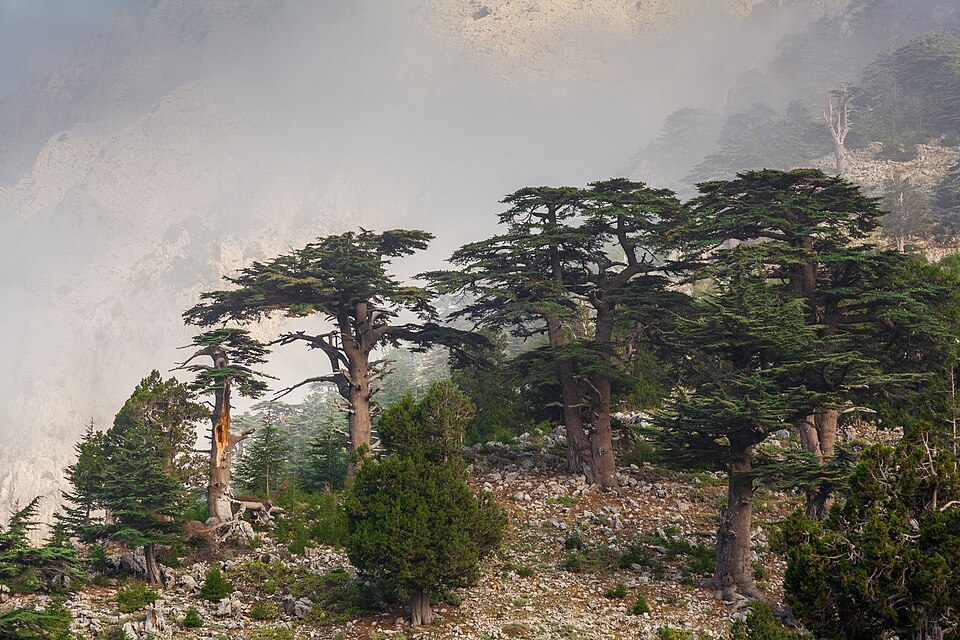
Featured Image Caption: Lebanese cedar(Cedrus libani A. Rich.) trees at Beydağları Coastal National Park. Lebanese cedar is a common plant found and used in urban planning in Turkey. https://commons.wikimedia.org/wiki/File:Lebanese_cedar.jpg
Primary Source Article: Erol, M., Cicek, N., & Yucedag, C. (2026). Physiological Responses of Three Urban Needle-Leaved Tree Species to Traffic-Related Air Pollution. Water, Air, and Soil Pollution, 237(2), Article 107. https://doi.org/10.1007/s11270-025-08837-8
For anyone living in a big town or city, it comes as no surprise that air quality is far less ideal than living in the countryside. This is due to less green space, increased traffic emissions, and industrial processes. Unfortunately, air pollution not only affects human health, but plant health as well. Turkey is no exception to this rule. According to the General Directorate of Highways of the Ministry of Transport and Infrastructure, an average of 10,000 to 19,999 vehicles per day pass through the Isparta-Egirdir highway. These numbers increase during the summer.
In Turkey, researchers wanted to investigate plant stress of three tree species to low, moderate, and high air pollution based on traffic density. To accomplish this, they measured key physiological traits related to chlorophyll content, carotenoids, ascorbic acid, relative water content, leaf PH, and membrane stability.
At the end of the study, researchers discovered that all tree species made increasing adjustments to tolerate air pollution as pollution levels increased. The Lebanese cedar adapted to pollution stress best, while the Austrian pine (Pinus nigra Arn.) had the weakest adaptation response.
Three Different Sites, Three Different Evergreen Conifers


For the study, researchers chose the Isparta-Egirdir highway, Burdur Mehmet Akif Ersoy University, and Isparta-Davraz Mountain as their most polluted, moderately polluted, and least polluted sites, respectively. This decision was based on the average number of vehicles that pass through these areas. Vehicle exhaust is associated with the release of heavy metals and is a major contributor to air pollution. The tree species chosen for the study –Lebanese cedar, Greek juniper (J.eniperus excelsa Bieb), and Austrian pine – were chosen because they are commonly used for roadside afforestation in Turkey.
Leaves from five trees of each tree species facing toward and away from traffic at each site were collected for testing.
How do you Test Evergreens’ Pollution Tolerance? Details Create the Big Picture
Like all living things, plants have different ways of responding to environmental pressure. In this study, researchers paid special attention to chlorophyll content, carotenoids, ascorbic acid, relative water content, leaf pH, and membrane stability.
When you analyze these measures together, you can better understand the health status of the plants exposed to heavy metals and other pollutants. With these factors, the researcher is essentially asking what happens to the plant’s ability to produce food, fight oxidative damage, retain water, maintain their cells, and deal with stress.
A researcher can bundle all of these factors into a formula called the air pollution tolerance index (APTI) that determines whether a plant is sensitive, moderately tolerant, or tolerant to pollution on a scale of 1-17, with1 being the least tolerant and 17 being the most tolerant.
Stop Beating Around the Bush: Reveal the Results of the Conifers
All three conifers were negatively affected by pollution compared to their own species in less air polluted areas defined in the study. The average of total chlorophyll, carotenoids, leaf pH, and membrane stability index decreased the most in heavily polluted areas compared to less polluted areas. However, vitamin C, water content, and tolerance to pollution increased as pollution increased.
Researchers noted that a decline in chlorophyll content meant that a plant was exposed to air traffic pollution.
However, when comparing the performance of the Lebanese cedar, Greek juniper, and Austrian pine to each other under different pollution conditions, researchers noted that each species had a unique stress response. The Greek juniper increased its chlorophyll content and carotenoids in response to more pollution. The Lebanese cedar increased its Vitamin C in polluted areas.
Both the Lebanese cedar and the Greek juniper maintained their membrane stability index while stressed, but the Austrian pine’s was lowest among the three species. This meant that the Austrian pine’s cells were more prone to breaking down in response to pollution in comparison to the other tree species. In addition, both the cedar and juniper increased their water content and pH to cope with pollution.
Highlighting the Power of Vitamin C, Chlorophyll, and Carotenoids
The researchers learned that, even though plants have the same mechanisms to defend themselves against environmental stress, they can have different species-specific responses. Of all the physiological traits studied, vitamin C appeared to be the most effective in detoxifying and protecting plants from pollution stress. According to the researchers, this is because vitamin C not only detoxifies plants of radical oxidative species (ROS), but can also regenerate other antioxidants.
Additionally, plants with a high chlorophyll and carotenoid content are able to withstand pollution-related damage.
Why Care About Plant Health? If a Plant Can’t Protect Itself, It Can’t Protect You
Although plants can act as air filters, they are not immune to the stresses of pollution. Pollution can impact their ability to perform photosynthesis and other metabolic processes. This current study adds to the research defining the different tolerance levels that each plant species has to pollution. If a plant can’t support its own metabolic functions, it isn’t likely to provide the full benefit of protection in urban environments.
Researchers assert that these factors are important in evaluating which trees are best to plant in urban planning and monitoring pollution. However, this information is not just useful for urban planners and local governments, but for individuals who want to make informed decisions on which plant is best for their living space, especially if they live in urban areas.
Unfortunately, the study did not include direct and real-time air quality measurements of particulate matter (PM 2.5, PM10), nitrogen oxide (NOx), or heavy metals. Instead, they relied on choosing a high-traffic area for their pollution difference. Perhaps, future studies could incorporate this and include other plant species relevant to other regions. The question of what plant is best suited to traffic pollution will still be a relevant question in the coming decades.
The key takeaway from the study is that when considering an ideal plant to use in urban areas, aside from weather tolerance to an area, a plant high in chlorophyll content and vitamin C is a good choice for pollution tolerance and protection.
Reviewed by: